Can we at least let the man be governor of Lousiana for a couple of years first?
Although, it wouldn't surprise me to see Bobby Jindal's name bandied about as the nominee in say 2016.
Showing posts with label Politics/Elections. Show all posts
Showing posts with label Politics/Elections. Show all posts
Thursday, February 14, 2008


Friday, February 08, 2008
Conservatives and the Future
A few days agothis post appeared at National Journal's The Corner talking about all kinds of excuses whey the conservatives are not going to be truly represented in this election, with McCain generally ceded the nomination with Romney's departure. James Antle talks more about the candidates and the general dearth of real conservative, viable candidates. And of course, talk radio is up in arms about McCain and the lack of a conservative candidate.
But the question for conservatives now is whether to support McCain or let a Democrat win by default because the Republicans won't turn out in numbers enough to vote against the Democrat. Of course, at times like this it would be easy to say, well we shouldn't let the perfect be the enemy of the good and conservatives should support McCain because the alternative may be unthinkable.
Well, to a certain extent I will fall into that camp as will a number of conservatives, if for no other reason that I believe if you didn't vote in teh election you have no right to complain about the results. But by the same token, conservatives can still send a message even if they are out of power. Sure, the conservative movement has suffered a set back. But we suffered one in 1960-1964 and for nearly two decades we were a backwoods organziation that survived to come on strong with Ronald Reagan. We can come back and here is how.
1. We simply cannot cede the battle ground. On every issue, on every piece of legislation, on every policy, conservatives must stake out their position, based on conservative principals and keep talking about it, to everyone who will listen and even to those who don't. I have seen the result of failing to expound on our principals first hand--witness Maryland.
2. We must start to recruit conservatives now for the next 10 elections. Let's face it, we don't have a deep bench of conservatives at the top of the pyramid and it may take a little longer to get some there. But politics is a game of long term and if we believe our message to be the right one, and historically it is, then we can't forget to build the ranks of leaders at all levels. It is not just our "bench" of top leaders like Governors or Senators, but also the "minor leagues" of local government, state houses and state senates where future leaders are made. We also must not forget business and education.
3. Keep the idea machine going. Unlike 1964 when think tanks like the Heritage Foundation or Hoover Institution did not exist, we still have idea factories like these think tanks working. What the Stanley Kurtz argued is correct, we need to do more to get these conservative thinkers in the faculties of large scale universities and the only way to do that is to allow academics to use think tanks as a stepping off point to tenure track professorships.
4. Do not get discouraged. In every long term human endeavor, there are dark periods. This is a dark period for conservatives. That doesn't mean we are defeated, but this is a time to take a breath, take stock and make a plan.
This is not to say we should just give upon McCain, but really if conservatives want a choice in 2012, we need to have an operation running now.
But the question for conservatives now is whether to support McCain or let a Democrat win by default because the Republicans won't turn out in numbers enough to vote against the Democrat. Of course, at times like this it would be easy to say, well we shouldn't let the perfect be the enemy of the good and conservatives should support McCain because the alternative may be unthinkable.
Well, to a certain extent I will fall into that camp as will a number of conservatives, if for no other reason that I believe if you didn't vote in teh election you have no right to complain about the results. But by the same token, conservatives can still send a message even if they are out of power. Sure, the conservative movement has suffered a set back. But we suffered one in 1960-1964 and for nearly two decades we were a backwoods organziation that survived to come on strong with Ronald Reagan. We can come back and here is how.
1. We simply cannot cede the battle ground. On every issue, on every piece of legislation, on every policy, conservatives must stake out their position, based on conservative principals and keep talking about it, to everyone who will listen and even to those who don't. I have seen the result of failing to expound on our principals first hand--witness Maryland.
2. We must start to recruit conservatives now for the next 10 elections. Let's face it, we don't have a deep bench of conservatives at the top of the pyramid and it may take a little longer to get some there. But politics is a game of long term and if we believe our message to be the right one, and historically it is, then we can't forget to build the ranks of leaders at all levels. It is not just our "bench" of top leaders like Governors or Senators, but also the "minor leagues" of local government, state houses and state senates where future leaders are made. We also must not forget business and education.
3. Keep the idea machine going. Unlike 1964 when think tanks like the Heritage Foundation or Hoover Institution did not exist, we still have idea factories like these think tanks working. What the Stanley Kurtz argued is correct, we need to do more to get these conservative thinkers in the faculties of large scale universities and the only way to do that is to allow academics to use think tanks as a stepping off point to tenure track professorships.
4. Do not get discouraged. In every long term human endeavor, there are dark periods. This is a dark period for conservatives. That doesn't mean we are defeated, but this is a time to take a breath, take stock and make a plan.
This is not to say we should just give upon McCain, but really if conservatives want a choice in 2012, we need to have an operation running now.
Thursday, August 09, 2007
Gingrich: Modern Presidential Campaigns Verging on the Insane
Given the latest news, it is very hard to disagree with the former Speaker's comments about presidential campaigning.
Potential presidential hopeful Newt Gingrich on Tuesday blasted the modern-day road to the White House as too long, too expensive and verging on "insane."Despite my general interest in politics, I too have found the debates painful to watch. I get more out of reading the transcript and have taken to doing that. The expense and the activity level are brutal and probably unnecessary. Gingrich, ever the idea man, offers a solution:
The former House speaker from Georgia said he will decide whether to enter the GOP presidential field in October. But in a wide-ranging speech at the National Press Club in Washington, he ridiculed campaign consultants and spin doctors who he said are extending the 2008 campaign. He said presidential debates have become "almost unendurable."
"These aren't debates," the former Georgia congressman said. "This is a cross between [TV shows] 'The Bachelor,' 'American Idol' and 'Who's Smarter than a Fifth-Grader.'"
Gingrich's answer to the problems would be to get rid of limits on campaign financing, which he said have made the problems worse by requiring more individual donations to meet the same goals, and to stage a series of "dialogues" among the major-party candidates -- once a week, for 90 minutes, for nine weeks before the elections.I love the campaign finance side of things, so long as there is reasonable disclosure. I also like the dialogues idea, but I wonder how it would work in a primary context, but I can see it in a general election context quite easily and like the idea a great deal.
Candidates would pick the topics, and their answers would be uninterrupted "except for fairness on time," he said.
"After nine 90-minute conversations in their living rooms, the American people would have a remarkable sense of the two personalities and which person had the right ideas, the right character, the right capacity to be a leader," he said.
Monday, August 06, 2007
Unions In 2008 Elections
Viathe AP:
However, I have to disagree with Mr. Sweeney's assertion of a "large role" in the Democratic takeover of Congress. Unions are still massive turnout machines, but the union members they turn out are not nearly as monolithic as they would tell you or as their senior leadership would indicate. In any large organization (and unions are large organizations), the rank and file are not nearly as unanimous in opinion as Sweeney and other labor leaders would have you think.
Union household make up less than 15 percent of the voting public, which while a sizeable bloc of voters, they are not the huge bloc that can sway the vote one way or the other. The movement away from unions is affecting their membership, with only die-hards remaining in the ranks and that means they will have less and less of a chance to alter the elctoral vote, simply on a matter of numbers.
Union membership is down. The labor movement has split in two. Conservatives control the White House, the Supreme Court and, until last year, Congress.The initial assertions are true, aside from public sector unions, like govnerment workers, transit unions and teachers unions, union membership has been in a decline, if not a freefall, in America largely due to a shift away from traditional manufacturing jobs to an information economy.
Yet AFL-CIO leaders say things are looking up as the nation's largest labor federation heads toward the 2008 presidential elections.
"We're stronger in many ways," said AFL-CIO president John Sweeney, in Chicago for the federation's executive council meeting and Tuesday forum with the Democratic presidential primary candidates.
Organized labor played a large role in Democrats taking over Congress in the midterm elections, Sweeney said, and is trying to hold on to that momentum going into 2008.
However, I have to disagree with Mr. Sweeney's assertion of a "large role" in the Democratic takeover of Congress. Unions are still massive turnout machines, but the union members they turn out are not nearly as monolithic as they would tell you or as their senior leadership would indicate. In any large organization (and unions are large organizations), the rank and file are not nearly as unanimous in opinion as Sweeney and other labor leaders would have you think.
Union household make up less than 15 percent of the voting public, which while a sizeable bloc of voters, they are not the huge bloc that can sway the vote one way or the other. The movement away from unions is affecting their membership, with only die-hards remaining in the ranks and that means they will have less and less of a chance to alter the elctoral vote, simply on a matter of numbers.
California Electoral Vote Initiative
Jonathan Alter looks at the effort in California to place a question on teh ballot that would change the state's electoral vote allocation from winner-take-all to proportional.
The point of the ballot question to change the allocation is of course political--every ballot question is, to some extent, political in nature--even the so-called benign ones. The fact that some Republican lawyer in California wants to get an advantage for his party in the state is no more surprising than a Republican voting for George Bush.
Of course this is "bad reform" because it is not good government, it is for "partisan purposes." Of course, what Alter and others like him forget is that they can do the same exact thing in vote rich Republican states, like Texas. In Republican North Carolina, a effort is underway in the legislature to make this exact change, only it will benefit Democrats. Alter addresses North Carolina thusly:
Look, no one doubts that the electoral college is confusing and quaint, but it does provide a modicum of protection against the vagaries of popular vote. The current winner take all in California and other states exploits and magnifies what may actually be small partisan advantages.
But using the law to change the law for partisan reasons is no more shady or underhanded when undertaken by one party or another. It is politics and it is a bloodport.
Our way of electing presidents has always been fer-tile ground for mischief. But there's sensible mischief—toying with existing laws and the Constitution to reflect popular will—and then there's the other kind, which tries to rig admission to the Electoral College for strictly partisan purposes. Mischief-makers in California (Republicans) and North Carolina (Democrats) are at work on changes that would subvert the system for momentary advantage and—in ways the political world is only beginning to understand—dramatically increase the odds that a Republican will be elected president in 2008.Gee, no indication there of how Alter feels about the issue.
The point of the ballot question to change the allocation is of course political--every ballot question is, to some extent, political in nature--even the so-called benign ones. The fact that some Republican lawyer in California wants to get an advantage for his party in the state is no more surprising than a Republican voting for George Bush.
Instead of laboring in vain to turn California Red, a clever lawyer for the state Republican Party thought of a gimmicky shortcut. Thomas Hiltachk, who specializes in ballot referenda that try to fool people in the titles and fine print, is sponsoring a ballot initiative for the June 3, 2008, California primary (which now falls four months after the state's presidential primary). The Presidential Election Reform Act would award the state's electoral votes based on who wins each congressional district. Had this idea been in effect in 2004, Bush would have won 22 electoral votes from California, about the same number awarded the winners of states like Illinois or Pennsylvania. In practical terms, adopting the initiative would mean that the Democratic candidate would likely have to win both Ohio and Florida in 2008 (instead of one or the other) to be elected.Using the law for electoral advantage is what election lawyers are paid to do. The title of this ballot question is not false advertising, the ballot question is approved would re-form the California electoral vote allocation system into a different format--the very definition of reform.
Of course this is "bad reform" because it is not good government, it is for "partisan purposes." Of course, what Alter and others like him forget is that they can do the same exact thing in vote rich Republican states, like Texas. In Republican North Carolina, a effort is underway in the legislature to make this exact change, only it will benefit Democrats. Alter addresses North Carolina thusly:
The monkey business underway this month in North Carolina is just as egregious—though with only three or four electoral votes at stake, probably less consequential. Democrats, who usually lose the state in presidential contests but control the legislature and the governor's mansion, make no secret of their desire to win partisan advantage by going to the congressional-district formula.I don't know about Alter's legal interpretation, the state legislature and the California Constitution permit a pretty open ballot question process and other propositions of questionable nature have survived court challenge.
At least in North Carolina it's clearly constitutional. Article II, Section I of the U.S. Constitution stipulates that the selection of electors is up to state legislatures "in such manner as the Legislature thereof may direct." When power is delegated to the electorate in referenda, the legal authority gets fuzzy; the Constitution, of course, supersedes state law. In any event, the Hiltachk referendum will face a challenge in court.
Look, no one doubts that the electoral college is confusing and quaint, but it does provide a modicum of protection against the vagaries of popular vote. The current winner take all in California and other states exploits and magnifies what may actually be small partisan advantages.
But using the law to change the law for partisan reasons is no more shady or underhanded when undertaken by one party or another. It is politics and it is a bloodport.
Wednesday, August 01, 2007
Rep. Jennings Paid No Payroll Taxes for Campaign Staffers
Oops.
Stupid.
Democratic congressional candidate Christine Jennings went more than a year without paying taxes on both of her campaign committees’ payrolls, Federal Election Commission (FEC) reports show.Jennings claims to have found the error internally, but this is a pretty big error to go unnoticed for several months, let lone years.
Jennings paid no payroll taxes on one committee, “Chris Jennings for Congress,” until May 23 of this year, more than three years after its first salary payment. On another committee, “Christine Jennings for Congress,” Jennings paid no payroll taxes until July 31, 2006, about 13 months after its first salary payment.
“Chris Jennings for Congress,” which Jennings used for her 2004 campaign in Florida’s 13th congressional district, lists a lump sum of $23,835.93 paid to the IRS on May 23. The payment came after years of inactivity.
The latter committee, which she used for her 2006 bid for the same seat, includes 15 separate payments to the IRS totaling more than $100,000 between July 31 and the end of 2006, but no payments prior to that period.
Jennings announced two weeks ago that she would run for the seat again in 2008.
Stupid.
Friday, July 27, 2007
Can a Big Change In Congress Be on the Horizon?
For a long time, and in a number of posts, I have noted that Americans are quite funny about their views of Congress and their personal Representative. Usually, most people dislike Congress as a collection of individuals and as a unit. They don't dislike the idea of Congress, only those people who hold office. At the same time, though most Americans "love" their own Representative. The result is that Congress has dismal (14%) approval ratings, but pollsters rarely ask people about the opinion of their personal Represenative. Given that most incumbents are re-elected when running, it is not unreasonable to assume that at the very least, most Americans don't hold a negative opinion of their Representative. But in the latest Battleground 2008 poll published by George Washington Univeristy, there is an indication that Americans may be getting dissatisfied enough to see some real personnel changes in Congress in 2008. The Washington Times' Elizabeth Miller writes:
Polling on individual Senators or Represenatives is difficult in a national poll, but clearly there is an undercurrent of distruct that is beginning to permeate the electorate. Of course, translating that distrust into support for challenger candidates is a far more difficult task. While challengers have always had a tough road to hoe when running against incumbents, right now incumbents have a major obstacle before them, how to make sure their individual constituency doesn't lump them in with the whole of Congress.
In the end, Congress has enough time to bail themselves out, but if the Do-Nothing Democrats continue on their path, self-destruction would seem to be the order of the day. Republicans, on the other hand, need to start presenting themselves as having learned their lesson and heard the message from 2006. But the pace of change in Washington is not likely to engender any sort of faith among voters. Promises by both parties have been routinely ignored once the election results are tabulated and I think that most of America not only remembers this, but is prepared to punish Representatives for it.
America's love/hate relationship with their Representative/Congress has diverged to far to be maintained. When over two thirds of Americans think that Congress is too partisan--somthing has to give--either partisanship or membership.
Cynicism about American politics has risen sharply in recent months, according to a new poll that finds growing numbers of voters feel the country is heading in the wrong direction and that fewer think politicians can fix the problems.Of course, the question that generated this finding probably did not ask what people's opinion of their representative was, but this ressult is the closest I have seen to asking just that question.
More than two-thirds of likely voters (71 percent) say their member of Congress puts party politics ahead of them, according to the latest George Washington University Battleground 2008 Poll released yesterday.
Polling on individual Senators or Represenatives is difficult in a national poll, but clearly there is an undercurrent of distruct that is beginning to permeate the electorate. Of course, translating that distrust into support for challenger candidates is a far more difficult task. While challengers have always had a tough road to hoe when running against incumbents, right now incumbents have a major obstacle before them, how to make sure their individual constituency doesn't lump them in with the whole of Congress.
"Cynicism may be the hot new political trend the politicians are going to have to fight against," said Brian Nienaber, vice president of the Tarrance Group, a Republican research team. "People hold such a cynical view of how things are run in Washington that they're going to have to try doubly hard."While a healthy cynicism about government is probably healthy for our nation, I think that size of the cynical viewpoint is something to behold and for Congress to be wary of.
In the end, Congress has enough time to bail themselves out, but if the Do-Nothing Democrats continue on their path, self-destruction would seem to be the order of the day. Republicans, on the other hand, need to start presenting themselves as having learned their lesson and heard the message from 2006. But the pace of change in Washington is not likely to engender any sort of faith among voters. Promises by both parties have been routinely ignored once the election results are tabulated and I think that most of America not only remembers this, but is prepared to punish Representatives for it.
America's love/hate relationship with their Representative/Congress has diverged to far to be maintained. When over two thirds of Americans think that Congress is too partisan--somthing has to give--either partisanship or membership.
Wednesday, July 25, 2007
Why The Democratics Candidates Won't Win the Conservative Democrat Vote
Michelle Malkin details the responses of two Democratic presidential candidates to a question about gun control.
But it was Joe Biden who lent the perfect frame to why the Democrats will never win in a state like West Virginia, a normally Democratic bastion. Quick background though. The questioner was one Jared Townsend from Michigan, who introduced his Bushmaster AR-15 as his "baby" and wondered what the candidates would do to protect his baby.
Biden's first line:
But it is completely in line with their vision of the world, a world in which the government controls all and liberty is reduced for everyone. The Framers knew that private gun ownership was not just a matter of self-defense against Indians or wild animals. Private gun ownership was about the survival of the nation, the fact that guns in the hands of individual citizens put a check on the power of the government in their lives. In the liberal world, only police and the military would have guns and the fewer of those the better.
While Joe Biden has zero chance of becoming President, the fact that front-runners Hillary Clinton and Barack Obama said and did nothing to assuage Jared Townsend's concerns, Townsend and those like him have much to fear from a Democratic administration.
New Mexico Gov. Bill Richardson was asked to respond first. CNN host Anderson Cooper noted that Richardson has "one of the highest NRA ratings." Richardson ran so fast from his record, you could see the Road Runner puff of cartoon smoke billowing at the base of his podium.Richardson babbled on about background checks and mentally ill buyers and blah, blah, blah. Moderator Anderson Cooper took pity on Richardson and moved to another candidate. Based solely on his background, Richardson should be wiping the floor with this crop of candidates, but he isn't and his performance in the "YouTube" debate is why.
But it was Joe Biden who lent the perfect frame to why the Democrats will never win in a state like West Virginia, a normally Democratic bastion. Quick background though. The questioner was one Jared Townsend from Michigan, who introduced his Bushmaster AR-15 as his "baby" and wondered what the candidates would do to protect his baby.
Biden's first line:
"I'll tell you what, if that is his baby, he needs help."The absolute disdain for gun ownership among law abiding citizens is just proof that the current crop of liberal candidates is so completely out of touch with not only the American people, but with American history.
Biden threw red meat to the blue audience. He was richly rewarded with loud applause. Biden showed off his lawyerly credentials and continued to wallop the YouTube gun owner: "I think he just made an admission against self-interest. I don't know that he is mentally qualified to own that gun." Why? Because he showed affection for his possession? Because he's an enthusiastic hobbyist? Because he talked about his gun the way Paris Hilton talks about her Chihuahua or Brad Pitt talks about his Ducati or Al Gore talks about his Priuses and compact fluorescent light bulbs?
But it is completely in line with their vision of the world, a world in which the government controls all and liberty is reduced for everyone. The Framers knew that private gun ownership was not just a matter of self-defense against Indians or wild animals. Private gun ownership was about the survival of the nation, the fact that guns in the hands of individual citizens put a check on the power of the government in their lives. In the liberal world, only police and the military would have guns and the fewer of those the better.
While Joe Biden has zero chance of becoming President, the fact that front-runners Hillary Clinton and Barack Obama said and did nothing to assuage Jared Townsend's concerns, Townsend and those like him have much to fear from a Democratic administration.
Thursday, July 19, 2007
Larry Sabato Predicts Dems Will Retain Senate in 2008
Professor Larry Sabato predicts that the Democrats will retain control or expand their narror margin in the Senate.
Of course, Sabato is looking only at numbers, with only brief references to national trends. To a certain extent Senate races are still local enough that incumbents have a decided advantage. But unlike House races, I think the Senate races are much more prone to the influence of national and presidential politics. If the Senate stays Democrat, start putting more money on a GOP President. It goes the other way as well.
Of course, Sabato is looking only at numbers, with only brief references to national trends. To a certain extent Senate races are still local enough that incumbents have a decided advantage. But unlike House races, I think the Senate races are much more prone to the influence of national and presidential politics. If the Senate stays Democrat, start putting more money on a GOP President. It goes the other way as well.
Tuesday, March 27, 2007
YouTube Outrunning the FEC?
I don't know if the title of Rich Lowry's piece at Real Clear Politics is accurate, but the anonymity of the video sharing site surely makes it the online video equivalent of Mrs. McIntyre's handbill in the same way that an anonymous or pseudonymous (is that a word?) blog is.
Will YouTube play a role in elections in the future? Without a doubt it will, but will the impact be so great as to fundamentally alter the manner in which elections are conducted and campaigns measured? I don't think so. YouTube will be a tool more of the dedicated "anti," someone opposed to a candidate or a cause that is willing to spend the time and effort to craft a video and the connections necessary to move past the tipping point in to viral status. That will be a rare video indeed that will have an impact. Even the "1984" ad attacking Hillary Clinton will have a minimal impact on the race.
Whether sites like YouTube will be regulated will be difficult at best and the current law does not appear to provide an avenue for the FEC to regulate YouTube or other video sharing services. Certainly, the "blogger" exemption would indicate that the FEC does not seem to think it has the power to regulate the services or the content posted by users. Congress will no doubt look at whether or not to regulate the content, perhaps even passing legislation to require disclosure of the creator. But coming on the heels of McCain-Feingold and its limitations on advertising prior to elections, such a move may not sit well politically. As was seen during the attempt to regulate bloggers, video posters on either side of the aisle may agree on nothing else but their ability to undertake their craft.
But YouTube already has its own mechanisms for determining the value of any given video. There are literally tens of thousands of politically relevant videos on YouTube, some will be good and other won't. Lowry points out at the end of his column:
For now, the Federal Election Commission doesn’t have YouTube entirely in its officious grasp, and that’s a wonderful thing. It helps make the video-sharing Web site a robustly unregulated — and thus invaluable — political marketplace.Like most political technology "innovations," I think it may be too easy to acribe to the new model some sort of "earth shattering" importance to the big initial splash.
It’s no accident that the most memorable political advertisement in recent years was posted anonymously on YouTube, the famous 1984-themed anti-Hillary Clinton ad. A takeoff on an Apple Computer Super Bowl ad, the spot featured a woman in a Barack Obama T-shirt throwing a sledgehammer at a video screen filled with an ominous Hillary. The sledgehammer could just as well have been aimed at all the regulators, politicians, media pooh-bahs and professional hand-wringers who perennially worry that the political debate is too “uncontrolled” and set out to better control it.
Will YouTube play a role in elections in the future? Without a doubt it will, but will the impact be so great as to fundamentally alter the manner in which elections are conducted and campaigns measured? I don't think so. YouTube will be a tool more of the dedicated "anti," someone opposed to a candidate or a cause that is willing to spend the time and effort to craft a video and the connections necessary to move past the tipping point in to viral status. That will be a rare video indeed that will have an impact. Even the "1984" ad attacking Hillary Clinton will have a minimal impact on the race.
Whether sites like YouTube will be regulated will be difficult at best and the current law does not appear to provide an avenue for the FEC to regulate YouTube or other video sharing services. Certainly, the "blogger" exemption would indicate that the FEC does not seem to think it has the power to regulate the services or the content posted by users. Congress will no doubt look at whether or not to regulate the content, perhaps even passing legislation to require disclosure of the creator. But coming on the heels of McCain-Feingold and its limitations on advertising prior to elections, such a move may not sit well politically. As was seen during the attempt to regulate bloggers, video posters on either side of the aisle may agree on nothing else but their ability to undertake their craft.
But YouTube already has its own mechanisms for determining the value of any given video. There are literally tens of thousands of politically relevant videos on YouTube, some will be good and other won't. Lowry points out at the end of his column:
Yes, there is plenty of vile and false material on the Internet. And things aren’t always what they seem — the anti-Hillary spot was created by a professional employed by a firm that was on contract with Obama. But the public can be trusted to separate the wheat from the chaff, which is its proper role in an open society. The hand-wringers look at the 1984 ad and see an awful trend, potentially dragging down our politics. Instead, they should see freedom. Get over it.Congress still operates from the position that it must be the guardians of political discourse, but such a paternalistic stance treats the voters like children or worse like idiots. The American public is more than capable of determining value.
Tuesday, February 27, 2007
Campaign Technology
Danny Glover has reprinted an article from National Journal that discusses the use of Google AdWords and search engine optimization techniques for campaign purposes. While I am not a big fan of the Googlebomb and other search engine optimiations, I like the idea of using AdWords as a low cost means of spreading a message.
Check it out.
Check it out.
Friday, February 23, 2007
The New Vulnerability of Hillary Clinton
Peggy Noonan's column today in the Wall Street Journal says that Hillary Clinton is less inevitable after the past week. The feud with Barack Obama and David Geffen notwithstanding, the only think inevitable about Hillary Clinton's campaign is that she was doomed to go down. As front-runner, that is the only place to go.
Certainly Obama has wounded her and rightfully so. But Hillary Clinton's downfall will not come from without, but from within. Some people point to her naked ambition, her slow-boil, slow-to-cool, anger, ability to keep a grudge and other personal attributes as the source of her pending fall. I doubt that the psycho-analysis is needed. The fact of the matter is that most Americans have a view of her and most of that view is not positive, whether for the above stated reasons or for anything else.
This week Hillary Clinton has demonstrated her ability to screw up big time. Her petulant cry to Obama to give back David Geffen's money and the money he raised is but a symptom of the problem. For so long, people have built her up as the nominee apparent that she has not stopped to think and build ideas. She is expecting support because of the mere fact that she is Hillary Clinton. Obama, Edwards and the rest of the field are building a campaign, Clinton thinks she has one.
Another case is point is the apology for the Iraq vote that the left keeps demanding. Now, I don't think she should apologize for any vote she has taken in her brief Senate career. The problem is that she keeps trying to obfuscate the issue by saying that the President mislead her. But that is a bigger lie. She probably had access to more information over a longer period of time than any other freshman Senator, but she keeps dodging the issue. Here is my advice to Hillary Clinton (probably the only advice I would give). The next time the question comes up, say "I voted in 2002 based on information available at that time. We know something different know and had I known then what I know now, my vote would have been different. But everyday, everyone makes decisions based on less than perfect information and Senators are no different. Do I have regrets about my vote, yes. But I don't doubt my vote at that time. I can't afford the luxury of doubting every vote I cast."
Now, of course she won't say that because such a statement requires a confidence in oneself that she lacks, that she may be on the wrong side of something and that scares her and her campaign staff. This, and not anything else, is what makes her vulnerable because her hubris cannot be avoided or mended.
Certainly Obama has wounded her and rightfully so. But Hillary Clinton's downfall will not come from without, but from within. Some people point to her naked ambition, her slow-boil, slow-to-cool, anger, ability to keep a grudge and other personal attributes as the source of her pending fall. I doubt that the psycho-analysis is needed. The fact of the matter is that most Americans have a view of her and most of that view is not positive, whether for the above stated reasons or for anything else.
This week Hillary Clinton has demonstrated her ability to screw up big time. Her petulant cry to Obama to give back David Geffen's money and the money he raised is but a symptom of the problem. For so long, people have built her up as the nominee apparent that she has not stopped to think and build ideas. She is expecting support because of the mere fact that she is Hillary Clinton. Obama, Edwards and the rest of the field are building a campaign, Clinton thinks she has one.
Another case is point is the apology for the Iraq vote that the left keeps demanding. Now, I don't think she should apologize for any vote she has taken in her brief Senate career. The problem is that she keeps trying to obfuscate the issue by saying that the President mislead her. But that is a bigger lie. She probably had access to more information over a longer period of time than any other freshman Senator, but she keeps dodging the issue. Here is my advice to Hillary Clinton (probably the only advice I would give). The next time the question comes up, say "I voted in 2002 based on information available at that time. We know something different know and had I known then what I know now, my vote would have been different. But everyday, everyone makes decisions based on less than perfect information and Senators are no different. Do I have regrets about my vote, yes. But I don't doubt my vote at that time. I can't afford the luxury of doubting every vote I cast."
Now, of course she won't say that because such a statement requires a confidence in oneself that she lacks, that she may be on the wrong side of something and that scares her and her campaign staff. This, and not anything else, is what makes her vulnerable because her hubris cannot be avoided or mended.
Friday, February 09, 2007
Leadership
In keeping with today's theme about the Presidential election, Phillip Mella has a great post about leadership today.
But here is the interesting fact about President Bush's leadership--it hasn't changed on this matter. If his new strategy in Iraq carries the day, he will be hailed as one of the greatest presidents in American history. He will be viewed as a visionary leader, who stuck to his position despite the public outcry and his vision carried the day. The problem with many of the current Democratic leaders both in Congress and aspiring to succeed President Bush, is that when the excrement his the wind moving device, they would have crumbled, noting that their vision was not the proper one at the time. Thus, leading from behind, following a fickle public opinion to inconclusions, the Democrats would have us believe that such a path is the proper one.
One however need not look furhter than Ronald Reagan, a man who had a vision of a world without the Soviet Union and while it didn't happen in his presidency, it did happen. All of Reagan's policies, foreign and domestic led to the victory over the Soviet Union. He never waivered from his belief and he was roundly chastised for it. Sounds awfully familiar.
[M]ost Democrats, in particular those running for president, are leading from behind. That raises the question of whether, at the presidential level, it is best to shape public opinion by providing bold, inspired leadership--even, or especially against long odds--or to craft policy decisions in response to the vagaries of public opinion? Clearly these candidates intuitively favor the latter.As I noted in the comments to Mella's post, leadership is about a vision and the fortitude to adhere to that vision, even in the face of overwhelming public opinion. While most people in America, including many in his own party, disagree with what President Bush has done with regard to Iraq (but not Afghanistan although it has the same end goal), few can argue that he has not stuck to his vision of a free and democratic Iraq. His failing may be in the means, but not the ends.
When taken in conjunction with Congressional turpitude and flaccid thinking on this subject, it's evident we're moving towards the strategically thoughtless position of hoping circumstances won't deteriorate in the Middle East. But, as Lady Thatcher astutely noted:
Hope is not an adequate defense.
But here is the interesting fact about President Bush's leadership--it hasn't changed on this matter. If his new strategy in Iraq carries the day, he will be hailed as one of the greatest presidents in American history. He will be viewed as a visionary leader, who stuck to his position despite the public outcry and his vision carried the day. The problem with many of the current Democratic leaders both in Congress and aspiring to succeed President Bush, is that when the excrement his the wind moving device, they would have crumbled, noting that their vision was not the proper one at the time. Thus, leading from behind, following a fickle public opinion to inconclusions, the Democrats would have us believe that such a path is the proper one.
One however need not look furhter than Ronald Reagan, a man who had a vision of a world without the Soviet Union and while it didn't happen in his presidency, it did happen. All of Reagan's policies, foreign and domestic led to the victory over the Soviet Union. He never waivered from his belief and he was roundly chastised for it. Sounds awfully familiar.
Stature Gap and More
The fellas at Powerline have this post about the difference in stature between the top three candidates in each party for the Presidency. McCain is a war hero and been heavily involved in every major legislative debate of the past 10 years. Rudy Giuliani successfully governed the biggest city in America to a successful turnaround in every category and was a national hero on 9/11. Mitt Romney has been a governor, a very sucessful businessman and ran the 2002 Winter Olympics in Salt Lake City to a profit making enterprise, despite all the scandals involved prior to his tenure. On the Democratic side:
While McCain has no executive experience, he does have a certain amount of gravitas. On the Democratic side, none of the top three have executve experience and John McCain himself has more years in the Senate that Clinton, Obama and Edwards combined. Executive experience is not the end-all, be-all requirement for Presidential aspirations, but it does make a difference among voters. Had it not, then we wouldn't have the pattern we have now.
Even if executive experience matters to many, if not most voters, the fact that the GOP leaders have significant experience does. Right now, the leading Dems are way light in the category and there is nothing they can do about it. That may be the reason why both Guiliani and Romeny are capable of taking on the Hilary juggernaut and win, even in meaningless polls taken some 600 days before the next election.
What about the Dems? They feature John Edwards, a rich trial lawyer who served one term in the U.S. Senate. His accomplishments as a Senator were practically nil, though he did manage to cast a vote in favor of a war he now says he abhors. The Democratic field also includes the even less experienced Barack Obama, who has two years in the U.S. Senate, and whose great life story contains nothing else that ordinarily might be considered a credential for high office. Finally, though Hillary Clinton is not without stature, much of it comes by virtue of being the wife of Bill Clinton. Since the end of her husband's term she's been a diligent Senator. But unlike McCain who is courageous and tries to lead, Hillary is timid and tries to jockey.There is another important factor in the GOP's favor--executive experience. Two of the top three contenders have real, demonstrable executive experience. The last president to come to the White House without major executive experence was John F. Kennedy. Lyndon Johnson had been Vice President, as had Richard Nixon, Gerald Ford and George H.W. Bush. (although, to be fair, Ford inheireted the office, at least LBJ did win one election to the Presidency on his own.) Former governors included Jimmy Carter, Ronald Reagan, Bill Clinton and George W. Bush. Look at the GOP, Guiliani has New York City, which has a larger population than some states. Romney has Massachussets. I might also add that both men were Republicans elected by overwhelmingly Democratic constituencies (another real plus).
While McCain has no executive experience, he does have a certain amount of gravitas. On the Democratic side, none of the top three have executve experience and John McCain himself has more years in the Senate that Clinton, Obama and Edwards combined. Executive experience is not the end-all, be-all requirement for Presidential aspirations, but it does make a difference among voters. Had it not, then we wouldn't have the pattern we have now.
Even if executive experience matters to many, if not most voters, the fact that the GOP leaders have significant experience does. Right now, the leading Dems are way light in the category and there is nothing they can do about it. That may be the reason why both Guiliani and Romeny are capable of taking on the Hilary juggernaut and win, even in meaningless polls taken some 600 days before the next election.
Wednesday, November 08, 2006
Improper Characterizations
Fred Barnes, in the Weekly Standard, characterizes the GOP loses yesterday as a shellacking. However, the turnover in the House and probably the Senate are really no worse than any other loses in the third election cycle of a presidential terms.
Historically, the President's party will lost 25-30 seats in teh house and 3-5 seats in the Senate. So lets take a look, House Democrats will have a net gain between 25 and 29 seats and did slightly better than historic averages in the Senate. Hardly a shellacking.
What Barnes does point out and appropriately so, is the developing split of the country along North/South lines. The battleground for control of Congress and national policy is shifting to the west. This is troublesome in some respects, but less so in others.
Barnes writes:
A realignment is when groups that are traditionally inclined to support one party suddenly and dramatically begin supporting another. I see no signs that point to a realignment in either state. Rather, I see populations of one kind or another expanding and with that expansion comes shifts in political views.
To be sure, the developments are troubling for conservatives, particularly in light of Arizona's defeat of a same-sex marriage prohibition amendment. But at the same time, all is not lost.
In reality, while a crushing defeat, the election is not a shellacking of historic proportions nor are their any realignments in the works.
Historically, the President's party will lost 25-30 seats in teh house and 3-5 seats in the Senate. So lets take a look, House Democrats will have a net gain between 25 and 29 seats and did slightly better than historic averages in the Senate. Hardly a shellacking.
What Barnes does point out and appropriately so, is the developing split of the country along North/South lines. The battleground for control of Congress and national policy is shifting to the west. This is troublesome in some respects, but less so in others.
Barnes writes:
What should worry Republicans most, however, is erosion of its strength in the West and in two states in particular: Colorado and Arizona. Fours years ago, Colorado was solidly Republican. Since then, Democrats have won a Senate seat, two House seats, the governorship, and both houses of the state legislature. At the state level, that's realignment.First, I think that the shifts in Colorado and Arizona are not so much a realingment (at least in terms I believe to be realignment, but a consequence of the phenomenal growth in those states. In teh last census and reapportionment, Colorado picked up one Congressional seat and Arizona two. Colorado was also close in population growth to picking up a second. As teh population has grown, the politics have become a little more muddled.
In Arizona, Republicans dropped two House seats and Republican Senator John Kyl got a mild scare. Kyl, by the way, may be finest and most able senator in Washington. He's certainly in the top five. Meanwhile, Democratic Governor Janet Napolitano cruised to victory.
A realignment is when groups that are traditionally inclined to support one party suddenly and dramatically begin supporting another. I see no signs that point to a realignment in either state. Rather, I see populations of one kind or another expanding and with that expansion comes shifts in political views.
To be sure, the developments are troubling for conservatives, particularly in light of Arizona's defeat of a same-sex marriage prohibition amendment. But at the same time, all is not lost.
In reality, while a crushing defeat, the election is not a shellacking of historic proportions nor are their any realignments in the works.
Some Good News for Conservatives
Eminent Domain protection ballot questions did exceedingly well last night.
The outrage over Kelo obviously fueled these efforts and it really is a bipartisan issue. At least some concepts of smaller, less instrusive government remain.
The outrage over Kelo obviously fueled these efforts and it really is a bipartisan issue. At least some concepts of smaller, less instrusive government remain.
Tuesday, November 07, 2006
Steele: Not so fast
That with less than 1% of the vote in, everyone is calling it for Cardin. The problem according to Michael Barone, whose opinion on these matters is just this side of fact, is saying that once again, the exit polling is showing a 8-10 point bias in favor of Democrats. In a state like Maryland, this could be the difference between winning and losing.
All is not dead yet.
All is not dead yet.
National Voter Hotline Reports Mechanical Problems Surge
I got a press release from the National Voter Hotline who is reporting that of the calls they received so far today, the number reporting mechanical problems, that is problems with the operation of voting machinery has increased five fold over 2004:
 The locations with the the most reported problems were reported as follows:
Drastic changes have been recorded in the types of problems voters are experiencing on Election Day 2006:The following chart was also included:
Mechanical: The percentage of problems with voting machines and other voting technology has increased five fold. 15 percent of callers are reporting mechanical problems compared to only 3 percent in 2004.
Registration: Registration problems have decreased by nearly 15 percent. In 2004 registration problems accounted for 38 percent of the total caller complaints, in 2006 the number has dropped to 23 percent.
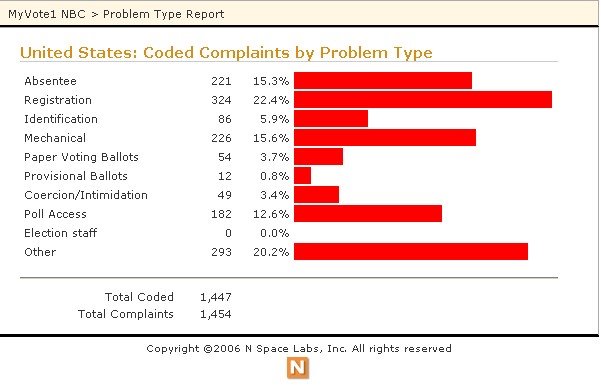 The locations with the the most reported problems were reported as follows:
The top five reporting counties are:
1. Wayne County, Michigan
2. Maricopa County, Arizona
3. Lancaster County, Pennsylvania
4. Los Angeles County, California
5. Oakland County, Michigan
MD-Sen: Fox News Carrying Lots of Coverage
The Maryland Senate race, thought by many a month ago to be a walk for Ben Cardin, is now considered a toss-up, and getting a lot of coverage. Will be watching throughout the day.
Exit Polling
Fox News reported earlier that exit polling data may start being distributed between 5:00pm and 6:00pm today (EDT), but what will it all mean. Mark Blumenthal has the scoop on how exit polls are conducted and what they mean.
Subscribe to:
Posts (Atom)