Wednesday, November 15, 2006

What Barack Obama and Michael Steele Have In Common Besides Race

For the past three months or so, hardly a political newscast goes by the doesn't talk about either the disintegration of the GOP or the emergence of Barack Obama, the young Illinois Senator who seems to be just shy of annointed as a "new black leader." While I have to admire Obama's PR team, I have begun to wonder why such a man has been viewed as the savior of the Democratic party and why he allows it.

Obama has been hailed as a "rock star" for the Democrats but he is still a freshman Senator from Illinois. As Ben Shapiro writes, Obama's main appeal is that he "understands" us. But
[w]ho is Barack Obama? He is a cipher running as a shaman. He has been in the Senate for two years. He has virtually no voting record; he has virtually no articulated positions. Ask his advocates, and they will describe him as "a breath of fresh air" -- but ask them about a single position he holds, and they will stare at you as though you are speaking in tongues. They will tell you, however, that Obama "understands" every position you hold. Clinton ran as "The Man from Hope." Obama runs as "The Man Who Understands ." As Obama puts it in his new book, "The Audacity of Hope," "It is at the heart of my moral code, and it is how I understand the Golden Rule -- not simply as a call to sympathy or charity, but as something more demanding, a call to stand in somebody else's shoes and see through their eyes."
Michael Steele is also being viewed by many in the GOP as a "rock star" on the rise, despite his being on the receiving end of a White House sandbagging regarding the RNC Chairmanship. Steele's presence on teh ballot in Maryland and widely acclaimed campaign for the Senate has vaulted him to the top of the pyramid among Conservatives. But there is also a constant focus on Steele's race. Like Obama, Steele is always labled as a "black republican" despite the fact that such things are not uncommon today, see Ken Blackwell and Lynn Swann, among others.

What is significant about both men is not their positions or partisan affiliation, but the fact that every time they are mentioned, they are noted as black. Of course, neither of them had any say in their genetics, but both have failed to put an end to the constant portrayal as black first and politicians second.

At a time when both men are acutely aware of the role of race in our society, neither have taken the time to correct the media. Obama is almost always referred to as the black Senator from Illinois, or a new black Democratic leader. Likewise, Steele cannot duck the black Republican label, nor does it appear as though he as made a signficant effort to do so. These men are among the top leaders in their party, rightly or wrongly, and yet both have allowed their respective parties to put their race first.

For this reason alone, both men do a disservice to America as a whole, by allowing, if not activly perpetuating, the concept that their race matters more then their politics. I don't agree with much of Obama's political positions, at least those that I know of. Similarly, I have much to agree with among Steele's position. But until they make sure the media, their PR teams, their supporters and detractors begin to think of them as a Democrat or a Republican first, they will not be seen as more than a symbol of what their parties are attempting to achieve among black voters.

Race matters in this country because we allow it to matter in a way that is detrimental to our country. When leaders like Obama and Steele allow others to use their race to define them, they allow race to matter and you can't move beyond race until you move beyond the belief that one's genetics define who they are.

Th Ethically Challenged Democratic Leadership

Speaker-To-Be Nancy Pelosi's choice for Majority Leader, Jack Murtha, has as many if not more, ethical shadiness as Tom DeLay. Michelle Malkin has commentary and Abscam video of Jack Murtha trying to make a deal with bribery.

At teh same time, tainted lobbyist Jack Abramoff points to between 6 and 8 "seriously corrupt" Democratic Senators. Of course, Democrats may have been hoping that Abramoff would go away or taint only the GOP when the Republicans were in power, but it turns out that Abramoff "helped" the Dems as much as the Republicans.

Cleaning up the "culture of corruption" is going to be hard when the picks for leadership look like they have been corrupted in the same way in which the Dems painted the GOP as corrupt.

DeLay may have broken the law. Duke Cunningham and Bob Ney apparently did or they would not have plead guilty. But it is difficult to be an agent of ethical change when the leaders being appointed are a part of the culture. Murtha is caught on tape dealing for a bribe. Why then is Pelosi backing this guy?

Captain Ed points to the past and notes that the Democrats are not better at ethics, just lucky so far.

Of course, ethical challenges are nothing new in Washington and sometimes the "ethically challenged" paintbrush gets slung about is a sloppy fashion. There is a far cry from taking lots of special interest PAC money (which is completely legal and overly regulated) and discussing the terms under which you will take a bribe. I am generally not in favor of using "ethics" as a partisan tool since, as we can see, it cuts both ways. However, in this case, what was good for the GOP goose must also apply to the Democratic gander.

Carnival of Education Open

Check it out over here.

Tuesday, November 14, 2006

Are Gifted Students Legally Disabled?

America's public schools work a bell curve, and the educational delivery system is one in which the large majority of the population is served, that is the bulge of the curve. The average student gets, usually, an average education. (The implications of this are not really the subjection of this post, but are worthy of discussion). Of course, focusing on the bulge means that students on either end don't get the attention and focus they need. For the average student, we can determine that the modern public education system is at least adequate.

But the true test of a school or school system's merit lies not with the students at the bulge of the curve but in how it deals with the students on either end of the bell curve; those with learning disabilities or other "negative issues" and those students who are academically gifted. To be sure, we as a nation have made significant strides in helping those students who are academically challenged through disability to get an adequate education. But what have we done with those on the upper end of the curve? Far too little I am afraid.

Which brings us to this interesting story via May It Please The Court? and Blawg Review and outlines a real, but largely unrealized problem with public education.

It seems that a 13 year old prodigy and his mother are suing the state to provide tuition payments to UCLA since the single mother can't afford it. The basis of the suit is the fact that California law requires that all students under age 16 attend school with limited exceptions. Furthermore California Education Code Section 56000-56001 holds that
all individuals with exceptional needs have a right to participate in free appropriate public education and special educational instruction and services for these persons are needed in order to ensure the right to an appropriate educational opportunity to meet their unique needs.
Now, reading further along in the code, it is seems apparent that the California Legislature intended for this section to apply to "special needs" kids, those with low-incidence disabilities that may inhibit their ability to learn in a normal classroom environment. This apparent intent served as the basis for the court ruling in the case of Levi v. O'Connell(pdf document).

The court ruled that the state is not required to pay for the tuition of Levi's extraordinarily gifted son at UCLA. Levi claims that under the California Constitution, the U.S. Constitution, No Child Left Behind Act and the Individuals with Disabilities Education Act, she and her son are entitled to have the California Department of Education pay for tuition at UCLA or face violation of the Compulsory Education law. (Opinion at page 5). The legal question turned on whether colleges are considered part of the Public School System which the state must support, meaning pay the bills. The Court found through prior precedent that colleges are not a part of the school system are guaranteed as free to students. (Opinion at 9-10).

While it seems that an appeal will be forthcoming on the question of whether being gifted is a disability, the appeal will almost surely fail, as outlined in the court's opinion that being gifted is not within the definition of disability as outlined by IDEA and California law. So the court challenge is likely to fail, but the question is raised. What is the state's duty with respect to educating gifted and truly extraordinarily gifted students?

For the most part, I believe most public schools can provide some services for most gifted students, just as they provide services for most learning disabiled students. But while services for even the most severly disabled students are provided, what services are provided for exceptionally gifted students. While many gifted students may fall into a category of students requiring an individualized education plan, what if that plan calls for educational services that cannot be provided by the K-12 system, as is the case with this California student. What if the child, in order to have an adequate education, needs upper level mathematics or science instruction? What happens when upper level high school courses don't go far enough? It would seem that collegiate activity is possible and even necessary, but who should foot the bill? College is not free although farsighted colleges may waive fees for "celebrity" students.

Unfortunately, education in America is not without resource limitations and clearly those students at the top of the academic ability bell curve would be the ones to naturally get the short shrift because it may be thought that they can learn the material without much effort by the system. But what does that say about our appreciation for their gifts? Is that not shortchanging their educational experience out of expedience?

I have no answers for these questions, although it is a question that needs answers. Just as not every child will play professional basketball, not every child will win the Nobel Prize. But some kids do each of these things and we should be advancing the education of those exceptionaly children who may one day win the Nobel Prize, just as we provide outlets for exception athletes.

What an Amazing Idea!!

The GOP lost, but they still have teh ability to influence the operations of the House, like taking this idea from Rich Galen (via Instapundit):
Assume the GOP ends up with 203-or so-seats when all the recounts are over. And say all 203 of those Republican Members of the House were to tell Steny Hoyer that they feel his pain over the Pelosi/Murtha thing and they have decided to vote for him for Speaker.

If Hoyer went into the election for Speaker with 203 GOP votes, he would only need to find 15 Democrats who don't like or trust Pelosi (not exactly a stretch) to get to the magic number of 218 - an absolute majority of the 435 Members - and Mrs. Pelosi would be a very important member of the House Appropriations Committee. Period.

Republicans could look the Popular Press squarely in the eye and say: "What higher level of bipartisanship can there be than crossing over the aisle to vote for the other party?"
Of course, it won't happen, but if you are looking for a more moderate Dem to run the House, Hoyer would be a good choice, but his moderation would probably not benefit the GOP in teh long run, but it certainly would be a massive flexing of the minority strength to play a huge part in denying Pelosi the Speaker's Gavel.

Something Fun for Political Junkies

Fantasy Congress is just like Fantasy Football or baseball, but it is all about Congress and legislation. I haven't decided if I am going to do it or not, but it looks like fun.

Monday, November 13, 2006

On the Other, Dems Also Looking to Self-Implode

While I am generally not in favor of doing things simply because of party loyalty, it seems the the Democrats are going to do something particularly stupid when it comes to leadership elections also, so stupidity is a non-partisan trait.

Just days after helping her win the House, Speaker to Be Nancy Pelosi is dumping Rep. Steny Hoyer as her guy for Majority Leader. I think the Influence Peddler has it right:
Let's take a look at the balance sheet. Hoyer has good relations with corporate donors and can raise money. He has legitimacy with the 'Blue Dogs' and the 'New Dems.' He has been a good soldier for Pelosi, and has made it clear in many venues that he has no intention of challenging her for leadership.
Pelosi is backing Rep. John Murtha.

Some people might look at Pelosi's support for Murtha as a reward for headlining an issue that helped the Dems win the majority. But I tend to look at it in terms of completely dimissing a person who worked very hard to help win the majority back, for the entire 12 years in which the Dems were in teh minority. Murtha is a kind of "Johnny come lately" to the leadership scene.

So, in what could be the first, most important step Pelosi can make as Speaker, she is going to ignore the efforts that Hoyer has made on their party's behalf, and at the same time, put into motion the machinery that could be her undoing. A deeat for Hoyer in the leadership races will all but assure that Hoyer, who is certainly more palatable to the country as a whole, will run against her in the next Speaker's challenge, assuming that the Dems keep control of the House.

Repubicans on the Verge of Self-Destruction

Bob Novak has the story of a possible GOP self-destruction when it comes to leadership races.
The depleted House Republican caucus, a minority in the next Congress, convenes at 8 a.m. in the Capitol Friday on the brink of committing an act of supreme irrationality. The House members blame their leadership for tasting the bitter dregs of defeat. Yet, the consensus so far is that, in secret ballot, they will re-elect some or all of those leaders.

In private conversation, Republican members of Congress blame Majority Leader John Boehner and Majority Whip Roy Blunt in no small part for their midterm election debacle. Yet, either Boehner, Blunt or both are expected to be returned to their leadership posts Friday. For good reason, the GOP often is called "the stupid party."
Now, as I have said before, I don't think it is fair to blame John Boehner for the losses last week, but Boehner is a member of the original GOP revolution in 1994 and it is time to pass the torch.

What is troubling though is not that Boehner will run or even win the leadership election, but that some viable candidates for leadership posts aren't stepping up to the plate. Boehner, being challenged by Rep. Mike Pence and Blunt, being challenged by Rep. John Shadegg, both seem favored to win.

Given that some dramatic change is necessary in order for the GOP to reassert its dominance in American political life, keeping both Boehner and Blunt would represent a lack of understanding of what happened on Tuesday. The House Republican apparently think they lost because of the war in Iraq. While the war may have been a compelling reason for the loss, it is not the only reason, and deluding themselves into thinking they lost because of the President will not win victory in 2008.

I don't know if Pence and Shadegg can lead the House GOP out of the wilderness of the minority, but I am sure that Blunt cannot. The problem with Blunt in particular was
demonstrated last Thursday when Blunt went to the Heritage Foundation to campaign for his retention as whip. He delivered a defense of earmarking, echoing the House appropriators' claim that the elimination of earmarks would do "nothing but shift funding decisions from one side of Pennsylvania Ave. to the other."

That is the view that led Republicans to earmark a "bridge to nowhere" and hundreds of other projects in competitive districts, hoping it would save them on Election Day.
I think that the Republican base was disgusted with the spending excesses of the former leadership and selecting a new one will signal a change that may energize the base once again around basic Republican principles, that of a smaller government and conservative ideas.

Friday, November 10, 2006

Amazing Analysis

While there are some parts of this analysis by Martin Knight over at RedState that I disagree with, I think it is brilliantly argued analysis. Furthermore, his recommendations are great!!
The main issue is for us to consider where to go from here on in. I see these major areas in which we have to concentrate on and improve:

[1] We need a return to first principles: Reaganism all the way. And while getting back in touch with our fiscal conservatism, let us not listen to those urging us to commit political suicide by throwing aside social conservatives who, contrary to popular belief are not all religious, or even interested in establishing a "theocracy" in the United States. One can be opposed to gay marriage and not be an adherrent of any religion. One can be pro-life without actually believing in God and one can be opposed to embryonic stem cell research without it being a directive from his Mosque, Church or Synagogue. And besides, why exactly is it considered unacceptable for someone to allow his or her religion inform his choice on who or what to vote for? Note that Democrats for all elected offices around the country since 2002 have loudly proclaimed their belief in God and campaigned in Churches perhaps even more so than Republicans e.g. Harold Ford.

[2] We need better leadership: We need to clean up our image; I hereby nominate Mike Pence/Marsha Blackburn for House Minority Leader, John Shadegg/Marsha Blackburn for House Minority Whip and Bobby Jindal/Jeb Hensarling for House Republican Conference chairman. I also nominate for your consideration Mitch McConnell as Senate Minority Leader (let us just hope his spine does not spaghettize - please Lord no more of this "Senate Collegiality" BS), John Cornyn/Jon Kyl as Whip works for me and John Sununu/Jeff Sessions would serve as Senate Republican Conference Chairman. I concur with the Directors and I enthuthiastically support Michael Steele for RNC Chairman. I doubt there's a better salesman for the GOP than Michael Steele today.

[3] We need better recruitment: This where Redstate.com as a Republican political entity can come in handy. In fact, this is where the entire Dextrosphere can have the influence over our party that the Kossacks and DUers have. We should play a big part in identifying and nominating candidates for races across the country. I believe this website should emulate FreeRepublic in one way and have sub-sites for each state i.e. md.redstate.com, ia.redstate.com, nh.redstate.com, etc. and a nominations sub-site where Redstaters can submit the names of local politicians, Republican activists or just plain good people who they think can run for any race, whether local, state or Federal and win it for the GOP. Our search should start now.

[4] We need a major image overhaul: This is where someone like Michael Steele as Republican National Committee Chairman comes in handy. He ran a magnificent and nearly flawless campaign. Unfortunately he was saddled with a party that has lost its way on the national stage, a President of his party that refuses to stand up for himself, in a year when the GOP forgot how to be a political party and allowed itself to be tainted in the eyes of the American public. And yet Michael Steele was able to garner 45% of the vote in a state in which Democrats outnumber Republicans by 2 to 1 and the President is as close to hated as it could get. If that is not impressive enough, he was delightfully creative and smart enough to wipe the floor with somebody who has been in politics for three times more years than him. We need to connect with African Americans and Hispanics. We need to have somebody who can make us look good and from his campaign Michael Steele understands that and knows to win good will.

[5] We need to remember how to play this game: The Press may have been carrying the Democrats' water and we may have been blindsided by Foley and maybe this was just the mid-term where the President's party suffers. But that doesn't change the fact that we lost to Nancy Pelosi, Harry Reid, Howard Dean and Arthur Sulzberger. Enough said.
One thing that Marint forgets though is the role that the NRCC and NRSC play in electoral politics. In 2008, the Dems have to defend just 12 seats in the Senate and the GOP 21. We must do a better job getting someone to head the NRSC in teh next cycle. NRSC rule prohibit Senator up for an election in the current cycle from sitting as the chair of the NRSC. That leaves Senators who were re-elected or elected in 06 and those up in 2010 as the possibilities. From the class of 2006, here are the options:

Bob Corker (TN)
John Ensign (NV)
Orrin Hatch (UT)
Kay Bailey Hutchison (TX)
Jon Kyl (AZ)
Trent Lott (MS)
Richard Lugar (IN)
Olympia Snowe (ME)
Craig Thomas (WY)

On this list, I would only think about Ensign and Lott and really Lott is the only choice from this list.

Of the Senators up in 2010, the list is:

Bob Bennett (UT)
Kit Bond (MO)
San Brownback (KS)
Jim Bunning (KY)
Richard Burr (NC)
Tom Coburn (OK)
Mike Crapo (ID)
Jim DeMint (SC)
Chuck Grassley (IA)
Judd Gregg (NH)
Johnny Isakson (GA)
Mel Martinez (FL)
John McCain (AZ)
Lisa Murkowski (AK)
Richard Shelby (AL)
Arlen Specter (PA)
John Thune (SD)
David Vitter (LA)
George Voinovich (OH)

Again, not what I would call a super stellar list of options. In this group, I would choose Bond, Martinez, or Vitter. McCain won't do it since he has presidential aspirations and none of the other strike me as solid enough campaigners to get the work done.

In the House, for NRCC chair, Eric Cantor (VA) is my choice with maybe Jeff Flake (AZ) a second choice. Both men are proven fundraisers, are young, charasmatic, solid conservatives who have not been in Congress long and could make a real difference in candidate recruitment, fundraising and tactical decisions.

While we are thinking about legislative leaders, we cannot forget about the electoral leaders either.

Educational Politics Starting Points

In the wake of the election and the opportunity afforded by upcoming legislative sessions, I posted these thoughts earlier, about a very different direction for American education. Many of the ideas that were mentioned have been percolating in my head for weeks, if not months. The item that really started to crystallize my thoughts was this piece by Eugene Hickok, in which he wrote:
A new vision of education in America should embrace the principles on which America is supposed to be based: freedom, equality, opportunity, responsibility and ownership. The status quo lacks freedom, and the façade of equality has allowed an achievement gap to haunt the nation. Millions are denied a real opportunity. Newly minted accountability systems have school administrators gagging and leave too many parents confused, resulting in too many failing to take responsibility for the future of our children.

As for ownership, our public schools have become institutions of government, serving bureaucracies rather than the public. It's as though the system owns us rather than we owning the system.

Imagine what education in America could look like with these new principles in place. With freedom, families could decide how best to educate their children. Equality would be measured in terms of the education children receive and each student's achievement, rather than merely in dollars spent per student. Responsibility would begin at home; parents would have the power to determine whether their children are receiving a quality education. This more robust notion of accountability would enable people to determine how much their investment yields in terms of a child's education.

Gradually, families might begin to take back ownership of their children's education. Ownership is essential, giving a sense of authority that could drive ongoing improvement in education. The relationship of family, child and education is direct and tangible, rather than distorted by the demands of a system.
My ideas, particularly as they relate to matters like an absolute right for parents to choose the school their children will attend (based in part on the New Zealand model) are somewhat radical when compared to current practices. But if we are truly looking to build a school system and educational environment for our children, we have to stop mucking around on the edges and find a way to make real advances.

If the principle behind No Child Left Behind is accountability, why, as Hickok asks, are we attempting to graft a very different form of accountability onto a system that traditionally has had none?

That question really is the foundational point of my argument for some radical ideas in education. I believe that the curricula that have been developed are adequate, sometimes they are watered down, but curricula can be made more stringent in a much easier fashion than altering the operation structure of a school system. By shaking up the foundational assumptions of how schools are built and run, we can shake up the educational bureaucracy.

Of course, those who will be reading my ideas will probably think that I have some utopian view of the politics of education. On the contrary, most of the ideas that I espouse I know will encounter massive resistance from entrenched interests. But the current failures of American schools to serve the poor, the minority and those who are otherwised disadvantaged have not escaped the electorate and certain groups of voters are seeking an accounting and will force one upon us if we are not improving our schools.

For decades, American policy makers have listened to all sorts of people about how to improve education, from the ivory tower academics whose own children attended private school, to the conflicted teachers unions, to demogogues and fear-mongerers. It is time to fall back on basic American principles; "freedom, equality, opportunity, responsibility and ownership." It is these traits that made America great and it is these traits that will make American education great.

What's Next for Michael Steele?

The Washington Times has an article suggesting that in Ken Mehlman's depature, the RNC has the opportunity to have Michael Steele head the national party. In the same article, Steele is mentioned for a Cabinet post, particularly Secretary of Housing and Urban Development. If offered Steele should take the RNC position for a number of reasons, but he should remain careful.

First, HUD Secretary is normally a political wasteland and even more so in a lame duck Cabinet with little chance of making an impact in the remaining two years of the Bush Administration with a Democratic Congress. HUD would do little to advance Mr. Steele's stature.

Second, housing is not a Steele issue. Theoretically, Urban Development may play to Steele's interest in opportunities for advancing minority achievement, but not likely. Steele generally has advocated private and personal development and HUD is a large government agency with large government programs. Large government programs are not what Steele has espoused both personally and politically. These are just not Steele's forte and while I am sure he could do a fine job, it is not in keeping with his general interests and values.

Third, Steele has run a state party and thus has experience in running political parties, having been the head of the Maryland Republican Party prior to his election as Lt. Governor. Granted, the GOP took a drubbing in Maryland this year, but that is not Steele's fault nor his responsibility. He ran a strong campaign, with some innovative use of advertising and personal appeals. Such differences in thinking while remaining true to conservative doctrine are exactly what is needed at this time and I think in the lead up to the 2008 election some innovation will be needed.

Fourth, while everyone is focusing on Steele as a black Republican with the possibility of reaching out to minority voters, that is not his only attribute and cannot taint the other attributes he brings to the table. As RNC chair he would have to head a massive fundraising operation in light of the 2008 presidential and congressional races pending. He is proven fundraiser. Steele is an articulate speaker, personable and engaging. As RNC Chair, he would bring a certain amount of personal appeal that Mehlman, despite his skill, lacks. While Mehlman was a good tactician, Steele can hire tactical skill, it takes leadership to run an organziation like the RNC.

Captain Ed agrees:
With all due respect to the White House, both Steele and the Republicans would be better served with Steele at the helm of the RNC. He instantly gives more credibility to Republican outreach efforts to minority communities, a key goal after years of writing them off as lost causes. He brings experience, as he has served as Maryland's Republican chair in the past, and after the midterms, the RNC needs someone with some seasoning from the trenches. He would have a much higher national profile at the RNC than he would stuck in the DC bureaucracy, perhaps even positioning him for a governorship or a Presidential run farther down the road.
. Others are likewise effusive with their praise

There are some potential drawbacks. On a number of social issues, Steele could charitably be called a moderate others may call him a liberal. It is not like Steele supports abortion or gay marriage (in fact he is adamantly opposed to both), but he is not opposed to affirmative action on most scores and there are probably some others as well. A Steele appointment may not be the conservative rallying cry that the GOP needs. One of Captain Ed's commenters noted that Rick Santorum would be a good choice for the GOP.

While I admire Sen. Santorum and his firebrand approach to some issues, what is needed is some practical experience in party operations and Steele has that. I think that Steele is a great choice.

A New Educational Politics Needed

Jay Mathews talks educational politics and doesn't like the sloganeering and vacuous promises that make up what we call educational policy debate. In particular, Mathews is:
still waiting for a political candidate to release a detailed analysis of one of the several inner city schools that have shown great improvement through a smart choice of principal and teachers, focused teaching and longer school days and years. I think a smart candidate would say: "This is what I am talking about. I am going to do to create more schools like this." Instead we just get nice-sounding slogans and irrelevant statistics.
I agree with the concept that political candidates don't really offer much in the form of concrete proposals. Given the pending legislative sessions in each state, and the fact that I am not a candidate for office, I am going to offer my own, admittedly radical plan for school structure reform.

1. Immediate Full County-based Choice for Parents. Now this is of course the most radical departure from the norm and would require some work, but I am not unmindful of the problems with school choice on a statewide scale, so why not on a county scale. Allow all parents, regardless of location to choose any school in the county for their children with a certain percentage of seats, call it 50 percent, reserved for residents of the geographic area where the school is located. The parents can then choose the school best geared for their children.

2. Expansion of Magnet School Programs. Many counties have some schools with magnet programs, with science and technology, languages, and performings arts usually topping the list. By encouraging the expansion of magnet programs in all or most schools, you can diversify the choices for parents. I would also suggest increasing or implementing magnet programs in elementary and middle schools as well, rather than normal focus of magnet programs at high schools.

3. Weighted School Funding. The state and local governments would do well to separate capital budgets from school budgets and put the construction and maintenance of school facilities into its own state and local budget line items, separate from teh actual education of the students. Then, with issues of physical plant removed "per pupil" expenditure, the funding for each student follows the student to the school the student and parents choose. Thus, the schools with more students get more money since they need to provide more services.

4. A Teacher Draft. This is a big one, but it would involve giving principals the power to hire teachers and could be conducted not unlike sports drafts, with the worst performing schools getting first crack at the available pool of teachers. Like professional sports drafts, each principal would be able to designate as "franchise teachers" a certain percentage of teachers in order to keep them out of the draft. A teacher could refuse a "draft" but only at a penalty (which I can't think of one right now, but I imagine smarter people could). Yes, I know that the unions will scream bloody murder on this score.

5. Merit Pay and Bonuses. In conjunction with the teacher draft would come pay differentials for teachers based on all sorts of criteria, from advanced degrees to working in poor performing schools, to success in preparing students for tests, value-added education, etc. The bonuses for the best teachers would be big, not a few percentages points amounting to a few hundred dollars after taxes, but significant, ranging from ten to twenty-five percent of base pay. Signing bonuses for going to poor-peforming schools and other incentives for teachers at all levels should be implemented.

6. "Commuter Schools" and "Virtual schooling." So many parents have to commute significant distances. If you have full choice within a county, you could construct schools along major commuter routes, allowing parents the option of choosing schools along their route to work rather than other schools. Such a choice could extend beyond county lines and could include schools near major employment centers rather than simply neighborhood schools. Along the same lines, utilizing available technology, you could expand the use of virtual schooling, permitting students in small groups from across the state or county to take specific courses, perhaps higher level courses not available in all places, in a virtual environment.

Of course, I recognize that some of these proposals are incredibly radical and certainly not my own. But if courageous lawmakers were to put all of these into one bill and be public about it, I would imagine that some of these ideas may take root as policy debates and topics, pushing the level of debate from platitudes and slogans to real discussion on the merits of real choice.

State legislative sessions will begin in January and February and now is the time to start talking about these ideas.

Impeachment

Via Michelle Malkin, some liberal mouthpieces are beginning a drumbeat for impeachment proceedings against President Bush. According to Michelle, former Rep. Liz Holtzman says there are four areas in which the President is ripe for impeachment:
lying about weapons of mass destruction to justify invading Iraq, allowing the torture of prisoners, leaking classified information and botching the federal response to Hurricane Katrina.
Keeping in mind that according to the Constitution, the President can be impeached for treason, bribery or high crimes and misdemeanors. I think that only the biggest moonbats in the country could think that the President has committed treason. There is no charge of bribery that could pass the laugh test in court. That leaves us with high crimes or misdemeanors, a quite vague term, but nevertheless, let us take a look at Holtzman's charges.

1. Weapons of Mass Destruction. This is the "Bush lied, people died" argument all over again. First, liberal shill NY Times noted in the run up to the election that archived documents point to weapons of mass destruction in Iraq. Now with that, what we have is at best a poor misinterpretation of data. However, given that Saddam Hussein had used weapons of mass destruction on Kurds and others in his own country, acting on solid intelligence information, even if wrong, is not a crime or a misdemeanor.

2. Allowing Torture. I am assuming that this charge has to do with supposed violations of the Geneva convention which prohibits torture of enemies. But here you have to prove a couple of things. First, that our enemies are signatories to the Convention and or otherwise are deserving of its protections. Given their actions, it would be a hard case to make. Second, you would have to prove that Bush actually ordered the torture. Crimes of omission are few and far between and notoriously difficult to prove. Third, and most importantly, Holtzman, Rep. Conyers and others would have to prove that the torture that may have occured violated some U.S. Law, not international law. True once ratified, treaties become part of U.S. Law, but good luck proving that.

3. Leaking Classified Information. This is a dumb charge. First, the President doesn't have to leak classified information, he has the ability to declassify anything he wants and then publish it on the web. Given that the Democrats and the media have long been parties to the leak of classified information, this charge would be a deadly snake that will come back to bite the Democrats on the hand. If you open up this charge, that gives the President the ability to call Democrats to the stand in his defense and look into their role in leaking classified information. If Conyers and Holtzman want to pursue this line of attack, they had better make sure they are willing to abandon their own party in the process.

4. Botching the Katrina Response. Leaving aside the fact that natural disaster initial response is the role of state and local officials (read Ray Nagin and Kathleen Blanco), simple bad performance is not an impeachable offense. If that were the case, we would need to impeach all of Congress, most of the executive branch and not an insignificant number of federal judges. Those in government are people and they make mistakes and they don't do things perfectly every time. Was the federal response to Katrina bungled, I think a good case can be made, but there were a lot of errors in that mess and only a few are President Bush's.

Impeachment hearing are quite possible, even probable, despite what Nancy Pelosi is saying. Will atricles of impeachment be drafted? They have been before and they probably will be again. But if impeachment is to be used as a political weapon, rather than a punitive measure for actual crimes by a president, they we set a dangerous precedent as a nation.

A Democratic Congress has the ability, without impeachment, to circumscribe the president's power, through checks and balances that already exist far short of impeachment. Revenge is a poor motivation for impeachment (the memory of Bill Clinton's impeachment still lingers obviously and the GOP was probably wrong to pursue impeachment), it is also a poor prescription for keeping power in two years.

Wednesday, November 08, 2006

Hastert Out of Leadership: Who's Got Next?

National Review Online is reporting that Dennis Hastert is not going to run for House Minority leader in January.

Boehner has been Majority Leader for only a short period of time and he has had to work his way back into leadership after being ousted previously. While I agree with many that he shouldn't be tainted with the losses, he is a member of the leadership that lost and that usually means a change in management.

That is not to say that he couldn't or shouldn't run for Minority Leader, but he will need to prove conservative credentials and need to show that he can lead the party back to majority status.

Mike Pence is a strong conservative and certainly a believer in the conservative principles that will likely win more. But does he have the chops to push both a legislative agenda and an electoral agenda? I am not sure.

To me, the most important race is not for Minority Leader or Minority Whip (which Blunt needs to vacate), but for Chair of the NRCC. Reynolds is out, obviously. Tom Davis was brilliant, but I wonder who would be best in teh position. One name that comes to immediately is Eric Cantor of Virginia. Cantor, is a committed conservative, but with enough fundraising and electoral savvy to put the NRCC back in control. I don't know if he has the charisma to get people to run for office, but he knows how to raise the dough. Reynolds did a decent job and Tom Davis before him was great, but going back to Davis is not a wise move.

I think a minority leadership of Pence and Shadegg coupled with Cantor at the NRCC, you may have the makings of a conservative team that can match ideas with political muscle. Make no mistake about it, the GOP needs to win on both the federal and state level in teh next two elections cycles of the 2010 redistricting is going to bleed the GOP dry if they are not careful.

Improper Characterizations

Fred Barnes, in the Weekly Standard, characterizes the GOP loses yesterday as a shellacking. However, the turnover in the House and probably the Senate are really no worse than any other loses in the third election cycle of a presidential terms.

Historically, the President's party will lost 25-30 seats in teh house and 3-5 seats in the Senate. So lets take a look, House Democrats will have a net gain between 25 and 29 seats and did slightly better than historic averages in the Senate. Hardly a shellacking.

What Barnes does point out and appropriately so, is the developing split of the country along North/South lines. The battleground for control of Congress and national policy is shifting to the west. This is troublesome in some respects, but less so in others.

Barnes writes:
What should worry Republicans most, however, is erosion of its strength in the West and in two states in particular: Colorado and Arizona. Fours years ago, Colorado was solidly Republican. Since then, Democrats have won a Senate seat, two House seats, the governorship, and both houses of the state legislature. At the state level, that's realignment.

In Arizona, Republicans dropped two House seats and Republican Senator John Kyl got a mild scare. Kyl, by the way, may be finest and most able senator in Washington. He's certainly in the top five. Meanwhile, Democratic Governor Janet Napolitano cruised to victory.
First, I think that the shifts in Colorado and Arizona are not so much a realingment (at least in terms I believe to be realignment, but a consequence of the phenomenal growth in those states. In teh last census and reapportionment, Colorado picked up one Congressional seat and Arizona two. Colorado was also close in population growth to picking up a second. As teh population has grown, the politics have become a little more muddled.

A realignment is when groups that are traditionally inclined to support one party suddenly and dramatically begin supporting another. I see no signs that point to a realignment in either state. Rather, I see populations of one kind or another expanding and with that expansion comes shifts in political views.

To be sure, the developments are troubling for conservatives, particularly in light of Arizona's defeat of a same-sex marriage prohibition amendment. But at the same time, all is not lost.

In reality, while a crushing defeat, the election is not a shellacking of historic proportions nor are their any realignments in the works.

Some Good News for Conservatives

Eminent Domain protection ballot questions did exceedingly well last night.

The outrage over Kelo obviously fueled these efforts and it really is a bipartisan issue. At least some concepts of smaller, less instrusive government remain.

Tuesday, November 07, 2006

Steele: Not so fast

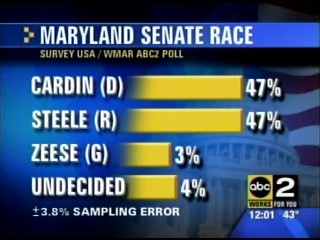
That with less than 1% of the vote in, everyone is calling it for Cardin. The problem according to Michael Barone, whose opinion on these matters is just this side of fact, is saying that once again, the exit polling is showing a 8-10 point bias in favor of Democrats. In a state like Maryland, this could be the difference between winning and losing.

All is not dead yet.

National Voter Hotline Reports Mechanical Problems Surge

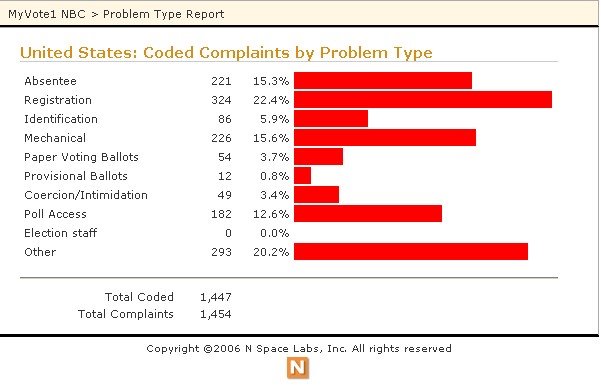
I got a press release from the National Voter Hotline who is reporting that of the calls they received so far today, the number reporting mechanical problems, that is problems with the operation of voting machinery has increased five fold over 2004:
Drastic changes have been recorded in the types of problems voters are experiencing on Election Day 2006:

Mechanical: The percentage of problems with voting machines and other voting technology has increased five fold. 15 percent of callers are reporting mechanical problems compared to only 3 percent in 2004.

Registration: Registration problems have decreased by nearly 15 percent. In 2004 registration problems accounted for 38 percent of the total caller complaints, in 2006 the number has dropped to 23 percent.
The following chart was also included:
The locations with the the most reported problems were reported as follows:

The top five reporting counties are:

1. Wayne County, Michigan

2. Maricopa County, Arizona

3. Lancaster County, Pennsylvania

4. Los Angeles County, California

5. Oakland County, Michigan

Robo-Calling: What will happen next

There is a lively discussion on the Election Law listserve about the topic of robo-calling, the use of automated messages to call voters with, usually, attack messages. The start of the thread dealt with a story at Talking Points Memo and discussed by the Washington Post dealing with a tactic of both parties, but more used by the Republican party to call voters with an automated process that will continue calling the voter if the voter does not listen to the entire message.

Part of the problem with these methods is that the rules governing them are part election law and part Federal Communication Commission rules regarding automated phone calls. Having not reviewed in detail the rules regarding automated calls, but relying on sources on the election law listserve who have solid reputations and integrity, I believe that some, not all, but some of the calls may be violative of the rules. The rules require that the call identify the name of hte sponsor up front and include a phone number to call if the recipient desires. Nearly every automated call I have received at my home (and as a mixed home, my wife being a Democrat and I a Republican, we get a lot of calls) has complied with the first part of the rule but almost never the second part.

Of course, if the calls violate the law, one could go to court and seek an injunction to prevent further use of the improper script. But the question of whehter pre-election litigation should be pursued is an interesting one. Certainly post-election litigation is moot, but since the tactic usually occurs close to the election, the last week typically, would pre-election litigation be appropriate? In light of the Supreme Court's decision in Purcell v. Arizona, such suits may not be well received by the courts.

I think the courts do need to stay out of disputes such as these. First, the savvy voter will find out quickly who to punish at the polls. Second, I think this year will be the end of robo-calling. The practice simply grates on too many people and will now be counter-productive outside of simple "remember to vote" calls. Third, Congress and the states will probably act in the next legislative sessions to tighten the rules somewhat to avoid the problem. The new rules will probably insist on identificaion and phone number up front, probably with a requirement that the call state it is an automated call up front. With the new rules, it is all but certain to force the end of robo-calling.

From a campaign operatives point of view, I can see the cost effective appeal of these calls. However, from a legal point of view, I can see how easily it can lead to fraudulent representations or misuse.

Again, I think most campaigns are going to abandon robo-calling for live callers, it is more personable and possible to customize scripts as needed depending on voter responses.

Polling Machine Problems

Fox News is reporting on the air about problems in Ohio and Tennessee with Diebold electronic voting machines. Harold Ford, Jr. was complaining of problems with the Diebold machines in the Memphis area (his home territory), giving the impression that it is because of the machines and Diebold looking to give the election to the GOP.

However, so far the problems reported in Ohio have happened to Republicans. Apparently the machine Rep. Jean Schmidt used failed. Rep. Steve Chabot came to the polling place with the wrong I.D. and had to go back home to get proper id.

Fun stuff.

I think that in the end most of the problems with voting machines will probably turn on human error. Human remain the weak link in any electoral system because they are human, meaning the may make mistakes.

However, Diebold's CEO is a big Republican and that will alway fuel the conspiracy theorists on the left. But when only one or two companies make voting machines, the market participants are too few not to generate suspicion. Perhaps we need more companies to make voting machines and perhaps we need to believe that a man's political outlook may not affect his ability to build or provide a good product.

MD-Sen: Fox News Carrying Lots of Coverage

The Maryland Senate race, thought by many a month ago to be a walk for Ben Cardin, is now considered a toss-up, and getting a lot of coverage. Will be watching throughout the day.

Exit Polling

Fox News reported earlier that exit polling data may start being distributed between 5:00pm and 6:00pm today (EDT), but what will it all mean. Mark Blumenthal has the scoop on how exit polls are conducted and what they mean.

Voter Frad in Philly

RedState is reporting of all kinds of fraudulent activty in some Philadelphia wards:
In wards 7, 19, 51 in Philly, PA, the crowds are going wild. Inside several voting locations, individuals have poured white out onto the polling books and the poll workers are allowing voters to go into the polls and vote without first registering. Several individuals are on hand demanding that voters vote straight Democrat.

RNC lawyers have headed to the scene of the incidents, which are occurring in mostly hispanic precinct locations. The District Attorney has also been contacted.

More from the ground: Reports of voter intimidation by son-in-law of Philadelphia City Commissioner in 19th Ward. Carlos Mantos is not allowing Republican poll watchers with valid poll-watching certificates monitor polling places.

Steele Gets More Last Minute Endorsements

In more proof of Lt. Governor Michael Steele's surge in the Maryland Senate race, yesterday, another crop of black clergy endorsed Steele. The latest group of pastors represent some 200,000 church members.

As the National Review Online noted, going after socially conservative black voters has been a key factor in his strategy, a strategy that is paying off.
These community leaders will provide crucial support to Steele's ground game in Prince George's County, where he must win at least 25 percent of the African-American vote in order to pull off the upset.

People who underestimate Michael Steele's appeal among black socially conservative voters are underestimating his chances to win this race. It's by no means a sure bet, but here on the ground in PG County, it's easy to imagine this passionate constituency can carry Steele to victory.
Steele's appeal is personal as well as pragmatic. For decades in Maryland, black voters have been left behind by the Democratic party and for Prince George's County, Steele's home, a growing black middle and upper classes are starting to realize that they have far more in common, fiscally and morally, with the GOP than with the Democrats. Steele's appeal comes from a number of areas.
Also, Steele, who spent three years training for the priesthood before opting for a career in politics, promises to represent social conservatives better than any Democrat. As the Democrats have become increasingly adamant in their defense of gay marriage and abortion, they have exposed themselves to the risk of alienating groups like MOOVVEITUP, a faith-based organization that is adding significant strength to Steele’s ground game.

It helps that Steele is an energetic and adept campaigner. As a black Republican in Democratic Maryland, he has learned how to appeal to supporters of big-government programs without sounding like he necessarily favors big government. He opposes racial quotas, but supports affirmative action as a means of economic empowerment. He’s against allowing the government to bargain down the prices of prescription drugs, but argues that Medicare doesn’t adequately cover the cost of prescription drugs for seniors. On education he holds a variety of complex views, including support for charter schools and vouchers at the local level. But he also will tell you that the problem with No Child Left Behind is its underfunded mandates.
Polls in Maryland close at 7:00pm EST and results will start flowing shortly after. However, Maryland has given out a record number of absentee ballots and we may not know who won for days, perhaps even a week.

Election Litigation

Unfortunately, election litigation is now a part of the electoral fabric. Prof. Rick Hasen has been getting a lot of calls:
The phone has been ringing off the hook today with reporters wanting to know the answer to the following question: will we know who controls the outcome of the House or Senate before we go to sleep tomorrow night, or is there the potential for this election to go to litigation?

First, let me disagree with the premise of the question, which assumes that it is only litigation that could delay the announcing of the results of the election on election night. In jurisdictions where many absentee votes have been cast (I just heard a report, which I have not verified, that up to 80% of Maryland voters are voting by absentee), it could take up to a few days for the ballots to be processed and a winner announced if the election is close. So we could have a delay even without litigation.
So delays in knowing what will happen are probably inevitable. Hasen thinks the most likely location for seat of your pants election litigation is the Missouri Senate Race.

We will have to watch what happens.

Monday, November 06, 2006

There is Only One Issue--The War on Terror

Orson Scott Card has this to say over at Real Clear Politics:
There is only one issue in this election that will matter five or ten years from now, and that's the War on Terror.

And the success of the War on Terror now teeters on the fulcrum of this election.

If control of the House passes into Democratic hands, there are enough withdraw-on-a-timetable Democrats in positions of prominence that it will not only seem to be a victory for our enemies, it will be one.

Unfortunately, the opposite is not the case -- if the Republican Party remains in control of both houses of Congress there is no guarantee that the outcome of the present war will be favorable for us or anyone else.

But at least there will be a chance.

I say this as a Democrat, for whom the Republican domination of government threatens many values that I hold to be important to America's role as a light among nations.

But there are no values that matter to me that will not be gravely endangered if we lose this war. And since the Democratic Party seems hellbent on losing it -- and in the most damaging possible way -- I have no choice but to advocate that my party be kept from getting its hands on the reins of national power, until it proves itself once again to be capable of recognizing our core national interests instead of its own temporary partisan advantages.
Here Card takes on cut and run Democrats:
Wherever Islamicism has been tried, the result has been identical to Communism's miserable track record. The people are oppressed; the worst sort of vigilantes and thugs terrorize the population; the new power elite, regardless of their supposed piety and dedication to a holy cause, is quickly corrupted and comes to love the wealth and privileges of power.

When there is no hope of deliverance, the people have no choice but to bow under the tyrant's lash, pretending to be true believers while yearning for relief. In Russia it came ... after more than seventy years. China and Cuba are still waiting -- but then, they started later.

So it would be in the Muslim world -- if Islamicism were ever able to come to seem inevitable and irresistible.

You know: If America withdrew from Iraq and Afghanistan and exposed everyone who had cooperated with us to reprisals.

As happened in South Vietnam. The negotiated peace was more or less holding after American withdrawal. But then a Democratic Congress refused to authorize any further support for the South Vietnamese government. No more armaments. No more budget.

In other words, we forcibly disarmed our allies, while their enemies continued to be supplied by the great Communist powers. The message was clear: Those who rely on America are fools. We didn't even have the decency to arrange for the evacuation of the people who had trusted us and risked the most in supporting what they thought was our mutual cause.

We did it again, this time in the Muslim world, in 1991, when Bush Senior encouraged a revolt against Saddam. He meant for the senior military officers to get rid of him in a coup; instead, the common people in the Shiite south rose up against Saddam.

Bush Senior did nothing as Saddam moved in and slaughtered them. The tragedy is that all it would have taken is a show of force on our part in support of the rebels, and Saddam's officers would have toppled him. Only when it became clear that we would do nothing did it become impossible for any high-ranking officials to take action. For the price of the relatively easy military action that would have made Saddam turn his troops around and leave the Shiite south, we could have gotten rid of him then -- and had grateful friends, perhaps, in the Shiite south.

That is part of our track record: Two times we persuaded people to commit themselves to action against oppressive enemies, only to abandon them. Do you think that would-be rebels in Iran and Syria and North Korea don't remember those lessons?
Then there is this segment about Bush's so-called mistakes in the handling of the war on terror:
Critics of Bush love to cite the many "mistakes" his administration has made. Most of these "mistakes" are arguable -- are they mistakes at all? -- and when you sum up the others, with any kind of rational understanding of military history, the only possible conclusion is that this is the best-run war in history, with the fewest mistakes. And most of the mistakes we've made are the kind that become clear to morning-after quarterbacks but were difficult to avoid in the fog of war.

Worse yet, Bush's opponents invariably depict these mistakes as being the result of deliberately chosen policies -- a ludicrous charge, but one that is taken seriously by an astonishing number of people who should know better. The game, you see, is blame. It's not enough to say, Bush made a mistake. You have to say, Bush deliberately did it wrong for evil purposes and he must be punished.

But let's accept the fairy tale that this war has been badly run. That still does not change the fact that on all of the biggest points, Bush has made exactly the right choice -- and he has been the only one who has even seen the need to make those choices!
Here are a couple of the money lines:
Every action has repercussions. Just as our withdrawal from Iraq would terrify and silence our allies everywhere, and embolden our enemies, so also would the fall of the ayatollahs -- particularly if it is as the result of an American intervention in the Gulf -- make waves everywhere. Democracy would be perceived as the wave of the future. Our friends in many countries would feel free to speak up for democracy and pro-American policies -- and their enemies would be afraid to silence them.

North Korea might go through a paroxysm of defiance -- but they would still understand the lesson. America will not be bullied by tyrants. We will stand for democracy, destroying our enemies at the "time and place of our choosing." Negotiations with North Korea would instantly take on a very different tone; and China's attitude, too, would become considerably more cooperative with us.

This is the victory that awaits us -- and it remains possible for two reasons only:

1. America's brilliant, brave, and well-trained military, which projects not just power but decency and compassion wherever our soldiers go, and

2. President George W. Bush, who, regardless of his critics and detractors, has steadfastly pursued the only course that holds the hope of victory without plunging us into a worldwide war with a united Islam or isolating America in a world torn by chaos.

Those are the scylla and charybdis that threaten us on either hand. If we do not win this containable war now, following the plan President Bush has set forth, we will surely end up fighting far bloodier wars for the next generation.

And the rhetoric of this election proves that we have precious few politicians in either party who have the brains, will, or courage to be taken seriously as alternatives to George W. Bush in the guidance of our nation through this dangerous, complicated world.


It is a long piece, but well worth the read.

Republicans, Race and Real Hypocrisy

Peter Beinhart, writing at the National Review Online, notes that in the years since George W. Bush's "inclusion" period prior to the 200 election, the Bush Administration has abandoned many of their promises, regarding immigration, race, and gays.

Beinhart notes efforts at courting Hispanics, blacks, and gays, saying, in a backhanded fashion, that these were good steps toward a big-tent party. But then there is this paragraph which actually destroys Beinhart's own thesis:
But it was easier then. In 2000, with the Massachusetts Supreme Judicial Court decision still years away, gay marriage was a distant glimmer on the political horizon, something Bush could largely avoid. As late as 2004, illegal immigration was still politically peripheral, which gave Bush considerable leeway in courting Latinos. And, from September 11, 2001, until sometime last year, Bush's war on terrorism was so politically potent that he didn't need domestic wedge issues to turn out the Republican base.
Yes, all the issues Beinhart is discussing that capture the voting public's attention today didn't exist in 2000 and so the President didn't have to take stands that seem to infuriate the Democrats.

First, while I believe the President believes that marriage should be between a man and a woman, I believe he and other Republicans don't like the manner in which gay marriage is being sought--through court decisions. If a state legislature or a voter referendum decided that gay marriage was proper, then I think the President would be more tolerant. He may not like it, but the will of the people will have spoken. The fact that even liberal states like Vermont (with civil unions), Massachussets and California don't have such legislative or democratically enacted gay marriage laws speaks volumes about the "widespread" acceptance of such an idea.

Second, on immigration, we face a real national security issue and perhaps a 700 mile long fence sends the wrong message, but on a 2,500 mile border, how much impact will it really have. Here the Democrats are playing as much of a race card as the GOP. The theory that Bush and the GOP hates Latinos belies a complete lack of understanding. If you speak to Latino immigrants here legally, you will find as much of a distatse for illegal immigration as the population at large. The issue is not about race, but about rules. If you come to this country illegally, you have violated the law and there must be consequences. An analogy is apt here.

If you have people coming into your yard and stealing from your fruit trees, you are losing money and/or the enjoyment of those trees. In order to prevent the theft, you seek solutions to your problem. The first of those steps might be a No Trespassing sign, which may deter those who were unaware that they were entering private property. The second step, when the theft continues, is to have guards patroling your land. When that fails, you build a fence. No one would deny your right to do so in order to protect your resources.

With immigration we have real theft. People come to this country, using our resources, paid for with our tax dollars, with impunity. Rules haven't stopped anyone nor have guards. The next step is to build a fence. But Democrats live in a world where we should all just get along, but the world is not that simple and people will steal from you if you let them.

Finally, on race, the Democrats are brazenly hypocritical on this score. Take a look at Democratic leadership across the country. There are some 22 Democratically held governorships in this nation, statistically there should be three Black Governors. There are none. There should be at least 5 black Senators--there is one. Maryland is a perfect example. In a state with 30% black population, there has been exactly one black statewide elected official--and he is a Republican. If race is such a key part of the Democratic foundation, how then do they explain so few blacks in positions of authority.

George W. Bush has the most racially diverse cabinet in history, with blacks, latinos and asians serving in Cabinet posts. In the senior most cabinet position, Secretary of State, Bush has had a black man and a black woman in that position. In Bill Clinton's Administration (supposedly the first "black" President), no black occupied a senior cabinet position--ever.

The hypocrisy of the left on these issues Beinhart points out cannot be justified nor can charges be leveled against the GOP with a straight face.

Today a Test for GOP Turnout Machine

With control of the House and Senate in jeopardy and the possiblity of reversing GOP trends in traditionally Democratic states, today and tomorrow will be tests for the vaunted GOP Get Out the Vote machinery. In the past three national elections, the GOP has dominated the field in this category of political work, but with the political winds apparently in chaos, can voter turnout prevent a Democratic takeover of the House?

As the Washington Post notes, the parties are laying it all out on the line:
A Pew Research Center poll showed a significant narrowing in the partisan advantage in House races that the Democrats have enjoyed for much of the year, findings that echoed those of a Washington Post-ABC News poll released Saturday showing the Democrats with a six-point edge.

The Pew poll showed that the Democratic advantage had dropped to 47 percent to Republicans' 43 percent among likely voters, down from 50 percent to 39 percent two weeks ago. The poll found a drop in Democratic support among independents, but Pew Director Andrew Kohut said the most significant change over the past two weeks is that Republicans now outnumber Democrats among likely voters.

Separately, a USA Today/Gallup Poll showed Democrats leading Republicans by 51 percent to 44 percent among likely voters on the "generic vote" -- the question of which party voters intend to support in House races -- down from a 13-percentage-point advantage two weeks ago. (emphasis added)
Professor Michael McDonald, who leads George Mason University's United States Elections Project, noted in a recent Washington Post op-ed 5 Myths About Turning Out The Vote ,
The Republican "72-hour campaign" will win the election.

Not necessarily. You can lead citizens to the ballot, but you can't make them vote.

Republicans supposedly have a super-sophisticated last-minute get-out-the-vote effort that identifies voters who'll be pivotal in electing their candidates. Studies of a campaign's personal contact with voters through phone calls, door-to-door solicitation and the like find that it does have some positive effect on turnout. But people vote for many reasons other than meeting a campaign worker, such as the issues, the closeness of the election and the candidates' likeability. Further, these studies focus on get-out-the-vote drives in low-turnout elections, when contacts from other campaigns and outside groups are minimal. We don't know what the effects of mobilization drives are in highly competitive races in which people are bombarded by media stories, television ads and direct mail.

Republican get-out-the-vote efforts could make a difference in close elections if Democrats simply sat on the sidelines. But this year Democrats have vowed to match the GOP mobilization voter for voter. So it'll take more than just knowing whether a prospective voter owns a Volvo or a BMW for Republicans to eke out victory in a competitive race.
In tend to think a little differently that Prof. McDonald. The GOP turnout machine tends to focus heavily on GOP voters. Well, duh, you might say, but is important. The people the GOP are calling and pushing to the polls are exactly those voters most likely to vote for the GOP. While the Democrats focus is largely centered around traditional constituencies like union households, blacks and other minorities or other generic classifications, the GOP targets individual voters. The difference can be seen in voting patterns.

Among Democratic GOTV efforts, the push on groups versus individuals, means that the Dems may turn out more voters, but they may lose a lot in the actual voting as people of these generic groups vote Republican. Witness union households, many of whom will vote Republican for a number of reasons, ranging from national security to immigration, not simply the Democratic line. Contrast that effort with the GOP voter turnout effort which has effectively micro-targeted voters to the point that nearly 100% of the voters they push to the polls will vote GOP. I don't have figures on how much of the Democratic turnout effort is lost due to GOP voters among traditional Democratic constituencies, but it may make a difference come Wednesday.

Democrats still wonder why the GOP turnout is so successful, showing the races tightening up at the rate they are:
Democrats, mindful of the Republicans' success in getting their voters to the polls in the past two elections, expressed nervousness at signs of tightening in some national polls. But they said private and some public polling in contested House districts continued to show their party in a position to win enough seats to claim the majority.

"I don't know what to make of it," said Rep. Rahm Emanuel (D-Ill.), chairman of the Democratic Congressional Campaign Committee.
Emanuel, among all Democrats, is probably the most politically savvy leader, in terms of electoral politics, to come around in a long time. He should know and apparently does not, or is not expressing why. Turnout efforts are largely a National Committee and state and local operation. Emanuel, whose public fued with DNC Chairman Howard Dean, may fall victim to poor planning and execution by the DNC and the state and local operations. One interesting little vignette in the Washington Post story is this one:
[New Hampshire Democrat]Paul Hodes is getting strategic advice from the DCCC but is relying mostly on a network of volunteers to turn out voters.

"You cannot buy G.O.T.V.," said Dana Houle, campaign manager for Hodes, referring to get-out-the-vote efforts. "You have to lay the foundation in terms of volunteer recruitment months beforehand."
This is a lesson on turnout from 2004 Ohio, where the DNC shipped in hundreds if not thousands of activists from outside the state in the waning days of that election, only to learn that local volunteers outperformed paid workers who lacked connection to local voters.

Turnout, despite what all the pundits and the Post may say, does win elections. The Ground war is the only war that matters, in military and in election campaigns.

Either We Win or You Cheated

These stories have been circulating for days, with Democrats claiming to be on the verge of winning the House and probably the Senate, they are also planning for the loss with stories like this one and this one that boil down to what Michael Grahman correctly notes as "we win or you cheated."

The funny thing is that both parties are guilty of looking for voting boogeymen at every turn. For the GOP it takes the form of voter fraud, the impetus behind many of the voter ID laws. For the Democrats, it is voter suppression--the idea that the GOP can't win unless it cheats.

In reality, neither form of "cheating" occurs on a great or even a medium size scale. Do people vote fraudulantly? Yes. Are there some voter suppression schemes? Yes. But again, not nearly as bad as everyone makes out.

Although Democrats have lead for months in the polls, the only poll that matters opens tomorrow and closes tomorrow. That is all. Whoever wins or loses does so on their own merits and nothing more.

MSNBC Poll on MD-Sen:

Hat Tip: Red State

Although you can read the poll yourself, I thought this was an interesting question and result:
In your view, did either of the candidates for U.S. Senate attack the other unfairly?

NO 24%

CARDIN DID 13%

STEELE DID 7%

BOTH DID 43%

NOT SURE 13%
To me this is an interesting question and I am not sure why the question was asked only in the Senate race. But Steele has gotten a lot of attention because of his advertising, a unique blend of personal discussion and lighthearted fun, while at the same time, Cardin's ads are predictably pedestrian.

Nearly twice as many people thought Cardin's attacks were more unfair to Steele. This is outside the polls margin of error, and while nearly half of all respondents said both men were unfair, I think that this question highlights an interesting split among the population. If the question can be fairly translated into support (a decent question), then Steele has an edge. This of course supposes that people will vote because of an ad campaign, which I tend to doubt in general, but Steele's relatively positive campaign, positive in that he has talked about ideas, may bring him victory tomorrow.

Ever Had Insomnia

and been watching really late night cable television? Sometimes cable will run one of those ads to call up and talk to singles and they have some really attactive women urging you to do so?

Well Mary Katherine Ham has convinced me to make some calls, which I have been doing anyway, but now I want my assignements from her.

Who said conservatives are sexy?

Steele on Fox News Sunday

Chris Wallace, of Fox News Sunday, interviewed Michael Steele and asked a question about the Washington Post endorsement of Ben Cardin:
WALLACE: Lieutenant Governor, the Washington Post endorsed your opponent, Ben Cardin, over the weekend, and they had some very harsh words for you. Let's put them up on the screen.

STEELE: Okay.

WALLACE: "Despite his efforts to construct an image as an independent-minded newcomer, there is nothing in Michael Steele's past — no achievement, no record, no evidence and certainly no command of the issues — to support it."

The Post says that as lieutenant governor for the past four years, you have had marginal influence.

STEELE: I know. Isn't it a shame? Well, you know, Chris, that is pitiful. It is absolutely pitiful, and that's nothing more than what the Baltimore Sun said about me four years ago, that I bring nothing to the table but the color of my skin. They were just a little bit more sophisticated in their ignorance.

My conversation with the editorial board didn't go the way they wanted it to go because I wouldn't kowtow and answer the questions the way they wanted me to answer them. I'm my own person. I don't care about the Washington Post. The Washington Post is not going to get me elected. The Washington Post is not going to prevent me from getting elected.

They're a bunch of folks, as I told them in the interview, who sit in an ivory tower, who have no clue what real life is about out here. It's easy to pontificate when you don't have to put a vote on the line, when you don't have to look a voter in the eye and let them know what you really think, so what — they come after me.

Now, how many times very you seen the Washington Post do a second editorial on a candidate that they didn't even endorse? It makes no sense. So clearly, I must be winning this race, and the Washington Post will have to write that headline, "Steele Wins", and then eat it.
Of course, that Steele didn't get an endorsement is not surprising, the Post has never, in the past 12 years endorsed a Republican who was not an incumbent. Steele never really had a chance to get this enorsement. But Steele is right, Cardin must need help if the Post thought a second endorsement editorial was needed.

Cardin and Steele were heavily in the black churches yesterday, Carding trying to repair a fractured support and Steele building upon his endorsements of last week. With the race now dead even in the polls, and momentum on Steele's side, the sprint to the finish today may make for some exciting stuff.

Friday, November 03, 2006

More Steele Momentum

Earlier this week, polls showed Cardin with a six point lead, which has evaporated in four days. This is getting exciting!!!!

WaPost on Campaign Finance

The editorialists at the Washinton Post have declared McCain-Feingold a success.

While it is true that the parties have been successful financially in this election cycle, apparently despite the ban on soft money, the bill is not a success. The law limits the ability of groups to speak about issues if they simply mention a candidate unless it is paid for with PAC money, despite the fact that not everyone has a PAC.

The Post Editors do have one good suggestion:
And the 2006 campaign has pointed up one particularly ridiculous aspect of campaign finance law that ought to be fixed before 2008: The rules limit how much political parties can spend on candidates in consultation with them but allow parties to spend unlimited amounts on behalf of candidates so long as they act "independently." Thus there is the spectacle of a Republican National Committee ad attacking Tennessee Democratic Senate candidate Harold E. Ford Jr. that the chairman of the RNC says he can't control -- because it was produced by an "independent" arm of the RNC. There's no good reason to force the political parties to engage in this charade of setting up independent groups.
Of course, the Post has to point up a Republican ad, without a comparative Democratic ad, whic do exist. But leaving that bias alone, the limits on coordinated expenditures and independent expenditures remains a very stupid regulatory environment. Parties, either party, should be able to advocate for its members without limitation--it is neither corruption nor the appearance of corruption. In fact it is expected.

Steele Endorsements Gaining Momentum

Yesterday, a group of clergy from Prince George's County Maryland, endorsed Michael Steele for the U.S. Senate. Hot Air has the video and an short interview with Steele. This endorsement, which comes on the heels of the endorsements of Prince George's County Democratic leaders on the County Council and others, demonstrates yet again, the momentum of a campaign of ideas. This latest endorsement is proof again that the Democratic chickens are coming home to roost. At a time when 25% of Maryland blacks are dissatisfied or very dissatisfied with the Maryland Democratic party, Steele has provided a viable outlet for their frustration. Focusing on education, opportunity and other issues of prime importance to the black community, Steele is doing something Ben Cardin the Democratic ticket has failed to do--take seriously the Maryland black voter.

When the P.G. County politicians endorsed Steele, a lot of people just sort of blew off the endorsement as one of nothing more than race, and you can be sure that the left wing netroots are going to call these pastors traitors to their race. But the clergy endorsement is huge for three reasons.

First, black voters who attend church, like all Americans, vote in much higher proporotions that non-church-goers. This fact has been proven time and time again in national election and voter behavior studies. For many of these black churches in Prince George's County, there is more in common with Michael Steele than with Ben Cardin and it goes beyond race. Steele's conservative approaches to family, individual responsibility and autonomy and other moral issues resonate well in this community. Steele's hard work in this community over decades is starting to pay off, both for him personally and politically as well as for the GOP.

Second, this endorsement cannot be seen as simply political, as many viewed the County Council endorsements. These endorsements are cultural and moral. These endorsements are about the ideas that Steele espouses.

Third, the endorsements, coming just five days before the election demonstrate that Cardin and Maryland Democrats have a race problem. For so long, the Democrats have been able to paint the GOP as the party of racism, of exclusion. Now one doesn't have to look to elsewhere in the country to find that the GOP is the party of hard work, of merit and of allowing people to be the best they can be. Which is what these church leaders are saying.

When Kweisi Mfume announced he would run for the U.S. Senate and the Maryland Democratic establishment hemmed and hawed about it and then breathlessly endorsed Cardin when he jumped in, the Maryland Dems practically signed their death political death warrant. I expect that other black leaders around the state are seriously thinking about Steele. They should.

Update: Mary Katherine Ham also has an interview with Steele.

Thursday, November 02, 2006

Teacher Quality Study

The American School Board Journal has an indepth report on the obstacles facing getting highly qualified teachers into classrooms. The report looks at five obstacles in the path: Teacher salaries, teacher assignment, turnover and attrition, teacher training, and licensing and certification.

Readers who have been visiting this blog for a while, know that I have some pretty strong opinions on teacher quality (see here, here, here, there, there, and oh yeah, this one) just to name a few. While the ASBJ does a good job outlining the problems, it is a little light on concrete solutions.

One of the interesting delimmas of the teacher quality problem is that we still don't know what it means to be a quality teacher. Subject matter knowledge matters as does teaching skill, and we all know quality teachers exist in every state and usually in every school. But how can we take what we know works and pass it on to future teachers. That was the subject of this post by Jenny D and a follow-up post of mine. Sharing and institutionalizing knowledge is the key, but how do we develop that habit among teachers, who spend much of their time working independently.

Once you overcome that obstacle, I would guess that you would see teacher quality improve dramatically.

Washington Post Online Discussion with Bob Ehrlich

The Washington Post hosted an online discussion with Maryland Governor Bob Ehrlich today. The transcript can be found here. This is one question that I liked:
Columbia, md.: You received the Washington Post, Gazette, The Capital, Easton Star Democrat, Herald-Mail, and I'm sure other newspaper endorsements. What do you think that says about your candidacy?

Robert Ehrlich: Columbia - You're keeping good score, but don't forget the Baltimore Examiner, Towson Times, Howard County Times, Laurel Leader, and others.

I am honored and humbled by the endorsements, particularly because these newspapers represent every region of Maryland. I have worked very hard to promote a "One Maryland" strategy as Governor so that every corner in the State enjoys better schools, safer neighborhoods and roads, expanded access to health care, and better job opportunities. The volume of endorsments shows we keep our commitments.
I can attest to this "One Maryland" strategy. My wife and I have lived in Prince George's County, Montgomery County and now Frederick County in Maryland. Governor Ehrlich has spent a great deal of time traveling the state, and no one, not even his most ardent opponents could classify Ehrlich as an "Annapolis" governor and I think that has translated to substantial support across the state. His numerous visits across the state address not only state concerns, but local concerns as well. Maryland, geographically, is not a large state does have some regional variation of interests and Ehrlich has done will to accomodate and addresses those regional issues.

Cardin and Stem Cell Research--Not What You Think

Later this morning actor and Parkinson's disease victim Michale J. Fox will make an appearance with Democratics Maryland Senate candidate Ben Cardin. I think anybody who thinks that Cardin is a supporter of stem cell research should carefully read this post by Big Lizard.

These are particularly desparate times for Ben Cardin. In a state with a 2 to 1 Democratic registration advantage, Michael Steele is within striking distance of winning is a massive upset.

Here is what is funny about Fox's appearance in Maryland. Chevy Chase, where the event will be held, is within spitting distance of the National Institutes of Health and a short drive from the biotech industry in Rockville Maryland. These places know what stem cell research is about, what it can and cannot do. This is an educated populace and they understand stem cell research, so Fox will not be able to pull the sympathy card as much as Cardin hopes.

Chevy Chase is Cardin territory. Why would he need to campaign there if he were comfortably ahead? Steele spends a lot of his time in what is supposed to be Cardin territory, drumming up support.

Once again, Cardin is playing up that Michael Steele is a bad guy because he is a Republican, but is still not offering up anything about what he would do as a Senator.

Wednesday, November 01, 2006

More on Blacks In Maryland

Some more good news for Michael Steele in Maryland. From National Review:
A new poll shows that a majority of black Democrats in Maryland are getting frustrated with the Democratic Party, both locally and nationally.

The poll found that 65 percent of black Democratic voters registered in Maryland say their party and its candidates should commit to issues of concern to blacks before asking for their votes.

Those least satisfied with the efforts of state party leaders are blacks between the ages of 35 to 65.

The same survey also found widespread dissatisfaction with the inclusion of blacks on the ballot for top offices.

One in four democrats in the poll said they were dissatisfied or very dissatisfied with the Maryland Democratic Party's direction on increasing diversity at the top of the Democratic ballot. Three in five said they were satisfied.

Thirty-two percent of registered black Maryland Democrats were bothered by the direction of the national Democratic Party on increasing diversity at the top of the ballot.

Snip

According to the poll, education and failing schools top the list of black voters' concerns: The poll found that 56 percent of black Democrats identified failing schools as a critical stumbling block in the paths of African Americans, while education is expected to drive as many black voters' decisions on Election Day as the war in Iraq is.

The statewide poll of 402 African-American Democratic registered voters in Maryland was conducted October 11-13, by Ariel & Ethan, LLC, a Bethesda-based polling and research company. The survey carries a margin of error of 4.9 percentage points.
With education and opportunity as Steele's longtime issues, this is a good break for him.

RCP Calls MD Senate for Michael Steele

Jay Bryant at Real Clear Politics says that the recent endorsement of GOP candidate Michael Steele by a group of African American Democrats "might be the most important political development in the country this week." According to
University of Maryland political scientist Ron Walters, yesterday's endorsements are "going to go through the black community like a rocket. It's going to be the talk of the county, the state, maybe even the nation."
The endorsements by all five of the black Democrats on the Prince George's County Council and former County Executive Wayne Curry come at a time when Steele needed the boost. However, Democratic candidate Ben Cardin (who is white) called it nothing more than an endorsement of Steele's race. Bryant notes that Steele is from Prince George's county, in fact prior to becoming Lt. Governor, Steele headed the county's Republican party and has spent much of his political career building in-roads for the GOP among the county's middle class and affluent black citizens.
Part of it is that Steele is a Prince Georgian. The county leaders know him, like him and respect him. But that alone wouldn't be nearly enough to cause them to break ranks with their party in a critical election.

What it's really all about is that blacks in Maryland have begun to realize that they've been being snookered by the white-dominated Democratic Party all these years. As Riddick put it, "They've been showing us a pie, but we never get a slice."

Voting statistics aren't kept by race, of course; they call it a "secret ballot" after all. But if you work out the math, you can pretty easily demonstrate that something like half of all Maryland Democratic voters are black. Half!

What have Maryland blacks gotten for their loyalty to the party? Virtually nothing. Oh, sure, they get representatives to legislative offices in districts where they have the overwhelming majority. Occasionally they get to be Mayor of Baltimore - although the current mayor is white, and running for Governor, something no black mayor could even seriously consider.

Indeed, in the entire history of the state of Maryland, exactly one person of African-American heritage has been elected to any statewide office. His name is Michael Steele.
But there are, I believe three other motivations and none have to do with Steele's race.

First, Steele is a massive proponent of education and is not beholden to the education establishment. The county, which is the wealthiest majority black county in the nation, still suffers from poor schools in much of its territory. Steele, who lead Maryland Governor Bob Ehrlich's commission on education, has been a big proponent of education change, including school choice and even vouchers. The Prince George's leaders want change in education and will support a leader who seeks that change.

Second, Steele, like many Republicans, strongly supports small business. While the black leaders and Steele may disagree on minimum wage and other workplace issues, all realize that small business is likely to bring about advancement in the county for poor blacks and anything that can be done to bring about more capital investment in the county the better off the county will be.

Third, and finally, there is a little bit of regionalism going on here. For decades, going back at least 50 years, all of the major state wide offices, Governor, U.S. Senator, Comptroller and Attorney General have been held usually by people (true, white people) from the Baltimore area. Aside from Parris Glendenning, Ehrlich's predecessor in the Governor's mansion, no non-Baltimore person has been governor in nearly a century. With the massive growth of the Washington suburban counties, like Prince George's, Montgomery, Frederick, Howard, and southern Maryland, many people are looking for a shift away from the Baltimore-centric politics of the past.

Many statewide offices this year will be won by someone not from the Baltimore area; not governor, since Ehrlich and Democratic candidate Martin O'Malley are both from Baltimore, but Attorney General (Republican Scott Rolle is from Frederick County and Democrat Doug Ganzler is from Montgomery) and Comptroller (where heavy favorite Peter Franchot is from Montgomery). The retiring Paul Sarbanes, who held the Senate seat Cardin and Steele are vying for, is from Baltimore as is Maryland's other Senator Barbara Mikulski.

These black leaders in Prince George's county no doubt believe that it is time that the U.S. Senate have a Marylander not from the Baltimore area.

Does race play a part, I am sure it does, and that is part of the appeal of Michael Steele to blacks. High profile endorsements like these from P.G. County and that of media mogul Russell Simmons (who endorsed Steele's opponent in 2002) may mean that, at least in Maryland, there may be a sea change in black voting patterns in the state. Six more days and we will know.

91st Edidtion of the Carnival of Education

Now open at the Median Sib:


Some good posts to check out:

NCLB: Let's Get It Right points out that NCLB has led to an increase of 3.9 million man hours spent on data collection and reporting--according to Paperwork Reduction Act statistics. The Irony, the Irony, the Irony.

Darren, at Right on the Left Coast, talks about transparency and his Union rebate check. Interesting changes from year to year.

California LiveWire talks about some of the freebies that come with textbook deals. While such benefits are common practice in business, are they bribes to get schools to buy textbooks. Perhaps, but if school boards and school systems provided some of the supplies given as freebies by textbook companies, perhaps such freebies wouldn't exist. Somehow I doubt it and teachers should not feel any guilt for freebies if it means they get good textbooks.